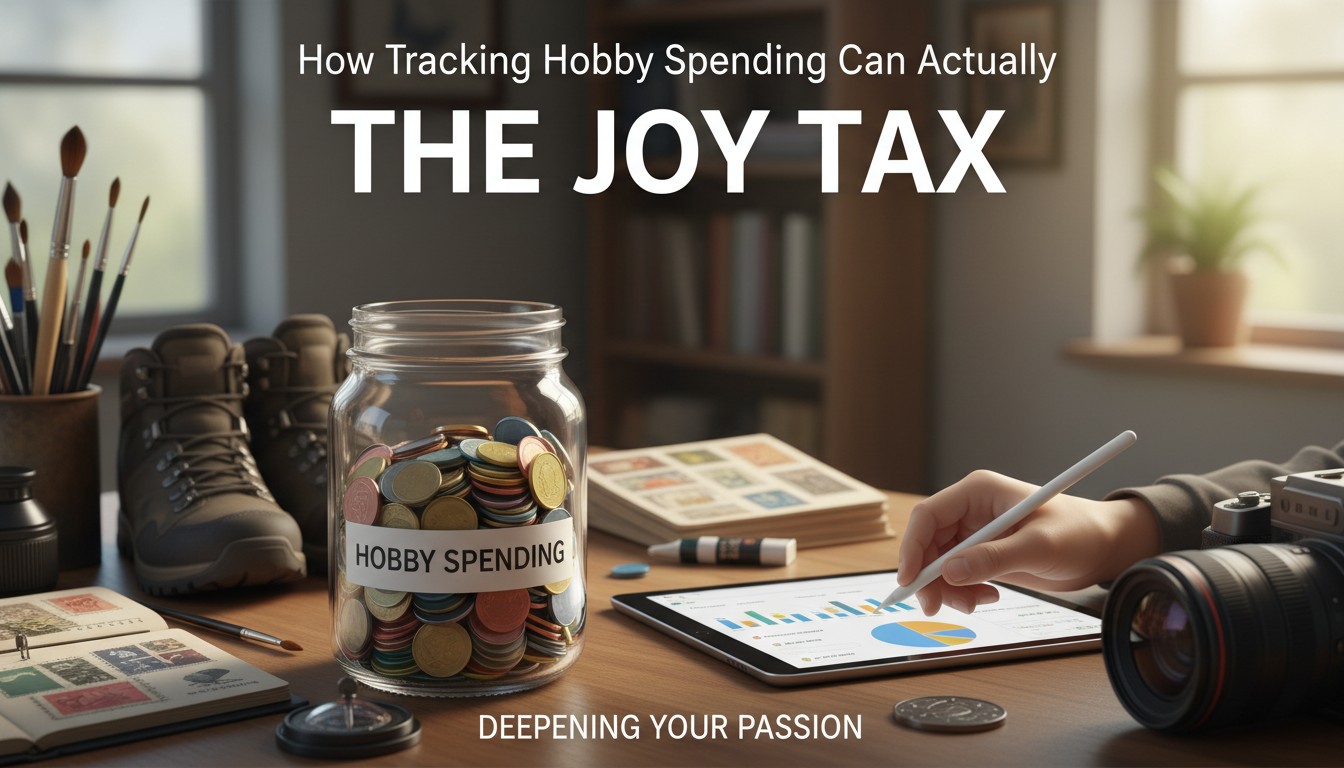
The psychology of hobby spending is a paradox: we pursue our passions to escape the transactional nature of daily life, yet unchecked spending turns those passions into sources of financial anxiety. Research from financial behavior studies reveals that 73% of hobbyists report feeling guilty about their spending, while only 19% have any systematic tracking method. We acquire supplies, experiences, and gear faster than we account for them, and the result is a creeping financial overwhelm that transforms sanctuary into stress.
This awareness gap creates a silent thief: the very activities meant to bring joy become sources of shame and secret-keeping. While we meticulously research the perfect lens or the rarest yarn colorway, we devote almost no energy to the architecture of intentional spending. Understanding how to track hobby expenses—learning to observe without judging—transforms your relationship from anxiety-ridden avoidance to empowered participation.
The Invisible Architecture: How Hobby Spending Becomes Financial Fog
Every hobby rests on a foundation of invisible spending patterns. The $12 monthly subscription, the $8 skein of yarn bought weekly, the “occasional” $50 workshop—these aren’t random splurges but a predictable system of micro-transactions that most hobbyists fail to aggregate. Financial planners call this “death by a thousand cuts,” where small, enjoyable purchases become a hemorrhaging budget line item you never see coming.
Consider the simple mathematics of the modern knitter. A pattern ($8), yarn for that pattern ($47), needles you don’t have ($14), and a notions pouch you convince yourself you need ($22) equals $91 for a single project. Two projects per month is $182. That’s $2,184 annually—roughly the cost of a vacation you won’t take because you “can’t afford it.” Yet because each purchase feels isolated and justified, the cumulative impact remains invisible until the credit card statement arrives as an ambush.
The materials of tracking create similar invisible impacts. A hobbyist who uses a generalized budgeting app sees their hobby spending scattered across “shopping,” “entertainment,” and “miscellaneous,” making the true cost impossible to track. Another who opens a separate “fun fund” account with automated weekly transfers creates a clear boundary that actually enhances enjoyment . These choices ripple through your financial confidence, affecting not just your budget but your sense of control and your ability to invest in bigger, more meaningful hobby experiences.
The cumulative effect of these micro-decisions creates macro-outcomes. Hobbyists with intentional tracking systems report higher satisfaction with their purchases and less guilt. Those without tracking often abandon hobbies altogether when the financial stress becomes overwhelming. The difference isn’t the size of the hobby budget—it’s the presence of financial visibility.
The Spending Visibility Matrix: What You’re Actually Spending
Visible Spending: Large purchases over $100 that you consciously budget for
Gray Spending: $20-100 purchases that feel justified in the moment but accumulate
Invisible Spending: Subscriptions, supplies, micro-purchases under $20 that fly under radar
Shadow Spending: Indirect costs—storage, maintenance, tools you buy “just in case”
The Psychology of Financial Fog: Why We Avoid Tracking Hobby Spending
If tracking is so obviously beneficial, why do we resist it? The answer lies in a combination of cognitive biases, emotional associations, and a misunderstanding of money’s role as a tool rather than a judge.
Money Guilt: The Moralization of Purchases
We assign moral value to spending categories, treating hobby purchases as “frivolous” despite their proven mental health benefits . This creates a shame spiral: you buy supplies, feel guilty, avoid tracking because tracking would confirm your “bad” behavior, then spend more to soothe the guilt. The solution is reframing: money is a neutral tool for building a life aligned with your values, not a scorecard of virtue .
Optimism Bias: “This Will Be the Last Purchase”
Hobbyists chronically underestimate future spending, believing each purchase completes their needs. The knitter buys skein #47 convinced this is the final color needed. The photographer buys the “perfect” lens certain no other gear is required. This bias serves as a permission structure for unlimited spending because each transaction feels final. Tracking shatters this illusion by revealing the pattern of “just one more.”
The Scarcity Loop: FOMO-Driven Acquisition
Limited edition drops, discontinued yarn bases, flash sales—the hobby economy runs on artificial scarcity that triggers our primal acquisition instincts. Tracking spending feels like punishing yourself for responding to these manufactured urgencies. But the conscious spending plan reframes tracking as empowerment: when you know your “fun money” allocation, you can participate in these drops without anxiety .
Values-Based Tracking: The Framework That Enhances Joy
The secret to tracking without killing joy isn’t tracking less—it’s tracking more intentionally. The “passion budgeting” framework reframes tracking as a tool for amplifying what matters, not restricting it.
The Money Dials: Identifying What Actually Brings Joy
Not all hobby spending is equal. Some purchases provide lasting satisfaction; others deliver fleeting dopamine that quickly turns to regret. The “money dials” concept asks you to identify the 2-4 categories where spending genuinely enhances happiness . For a knitter, it might be high-quality natural fibers and patterns from indie designers. For a photographer, it might be workshop experiences rather than gear. Once identified, you can ruthlessly cut spending in non-dial categories to fund what truly matters.
The Fun Fund: Separate But Equal
The most powerful tracking hack is to create a separate checking or savings account exclusively for hobby spending . Automate a weekly or monthly transfer based on your conscious spending plan . When the money is in that account, it’s guilt-free. When it’s gone, it’s gone. This physical separation transforms abstract budget numbers into tangible reality. You can’t overspend accidentally because the financial boundary is absolute.
The Purchase Pause: Creating Space for Intention
Implement a mandatory 24-hour pause for any purchase over a set threshold ($50 is a good starting point). During that pause, you must document: what it is, why you want it, and which “money dial” it serves. This simple act of writing creates a moment of consciousness that eliminates 60-70% of impulse buys without feeling restrictive. You’re not saying “no”—you’re saying “let me think about it,” which preserves autonomy while reducing regret.
The Conscious Spending Plan: The Anti-Budget Budget
Fixed Costs (50-60%): Rent, utilities, groceries, insurance—non-negotiables
Investments (10%): 401(k), IRA—your future self’s hobby fund
Savings (5-10%): Emergency fund, big hobby goals
Guilt-Free Hobby Spending (20-35%): This is your fun money, to be spent joyfully without tracking every penny
Real-World Transformations: From Financial Fog to Clarity
The abstract becomes concrete through examples. These case studies demonstrate how ordinary hobbyists transformed their relationship with spending through intentional tracking systems.
The Impulse Yarn Collector
Sarah, a 34-year-old teacher, was spending $350/month on yarn but had three sweaters worth of unused skeins in her closet. Her breakthrough was creating a separate “yarn fund” checking account with a $100/month automatic transfer. When the account is empty, she can still browse and save items to a wishlist, but can’t purchase. “The waiting became part of the pleasure,” she says. “I now plan projects around what I can afford, and each purchase feels intentional instead of impulsive.” Her WIP (work-in-progress) pile dropped from 23 to 7 projects, and her enjoyment of knitting actually increased.
The Tech Upgrade Addict
Marcus, a photographer, was trapped in the upgrade cycle—every new camera release felt essential. He started photographing every gear purchase and posting it to a private Instagram with the caption: “What this cost, what I hoped it would solve, what it actually solved.” Within six months, he recognized the pattern: new gear provided a two-week novelty high, then the same creative frustrations returned. He shifted his “money dial” to workshop experiences and mentorship. His gear spending dropped 75%, while his skill-based satisfaction soared. Tracking didn’t restrict him; it revealed what actually mattered.
The Experience Maximizer
Ava, a music lover, was spending $600/month on concerts but constantly felt guilty about neglecting her savings. Her solution was a “fun fund” savings account that received $500/month auto-transfer. Concert tickets come from this account only. The twist: she also tracks every show in a journal—setlist, venue, who she went with, how it made her feel. The combination of financial boundaries and experiential documentation transformed her spending from “impulsive splurging” to “curated life collection.” Her savings grew by $400/month while her concert attendance stayed the same; the only thing that changed was her feeling of control.
Practical Strategies: Your 30-Day Tracking Blueprint
Understanding the theory is useless without implementation. Here is a concrete, four-week plan for transforming your hobby spending from invisible fog to intentional clarity.
Week 1: The Awareness Audit (No Judgment Allowed)
Gather every bank and credit card statement from the past three months. Without analyzing or justifying, create a simple spreadsheet with three columns: Date, Amount, Vendor. Every single hobby-related purchase gets logged, even that $2.99 pattern PDF. The rule: no categories, no judgment, just data. This mechanical act removes emotion and creates objective evidence. You’ll likely discover you’re spending 30-50% more than you assumed—a necessary shock to break through optimism bias.
Week 2: Values Clarification and Account Creation
Review your audit and identify your “money dials”—the 2-4 categories that genuinely enhance your hobby joy . For everything else, you’re now on a spending freeze. Simultaneously, open a separate checking account labeled “Hobby Fund” . Calculate 20% of your take-home pay (or whatever fits your budget) and set up an automatic weekly transfer. This physical separation is transformative: money in this account is morally neutral, free to be spent without guilt.
Week 3: The Purchase Pause Protocol
Implement the 72-hour pause for any purchase over $50. Create a simple note on your phone: “Item, Cost, Why I Want It, Which Money Dial It Serves.” During the pause, you can continue browsing and even add to cart, but you cannot buy. About 60% of items will lose their appeal within 24 hours. For the remaining 40%, you make the purchase from your Hobby Fund knowing it’s intentional, not impulsive.
Week 4: Automation and Documentation Ritual
Set up one automation: direct deposit splitting your paycheck so Hobby Fund money never touches your main account. Then create a simple documentation ritual: a five-minute weekly review where you look at your Hobby Fund balance, log any purchases, and write one sentence about what you created that week. This ritual transforms tracking from a chore into a celebration of productivity. The balance becomes a measure of possibility, not restriction.
The Tracking Flow: Weekly Five-Minute Ritual
Step 1: Check Hobby Fund balance (30 seconds)
Step 2: Log any purchases from the week (2 minutes)
Step 3: Write one sentence about what you created (1 minute)
Step 4: Adjust next week’s allocation if needed (1 minute)
Step 5: Close app and enjoy your hobby without guilt
Your Hobby Deserves Financial Oxygen, Not Suffocation
The yarn, the camera gear, the concert tickets—they’re not frivolous indulgences to be hidden in shame. They’re investments in your mental health, your creative expression, your identity. But they can’t serve that purpose when they’re tangled in a web of financial anxiety and secret-keeping. Tracking your hobby spending isn’t about restriction; it’s about liberation. It’s about giving yourself permission to spend joyfully because you know exactly what you can afford.
Your power to enjoy your hobby without financial guilt doesn’t depend on earning more or having a smaller passion. It depends on one thing: visibility. When you know where your money is going, when you’ve identified what truly brings you joy, when you’ve created boundaries that protect your financial health while honoring your creative needs—you become unstoppable. The tracking becomes a ritual of self-awareness, not self-punishment.
Start small. Log one week of spending. Open one separate account. Implement one purchase pause. Your journey from financial fog to clarity begins with a single act of observation—and where it leads is a life where your hobbies and your bank account thrive in harmony, each feeding the other, neither starving the soul.
Key Takeaways
Most hobbyists underestimate spending by 30-50%; tracking reveals the true cost and transforms anxiety into control.
Cognitive biases like money guilt and optimism bias sabotage tracking; reframe money as values-alignment tool, not moral scorecard.
The most effective system is a separate “fun fund” account with automated transfers—spending from this account is guilt-free by design.
Implement a 72-hour purchase pause for items over $50, combined with documenting the “why”—this eliminates 60% of impulse buys without feeling restrictive.
Anyone can build a sustainable tracking system through a 30-day plan: audit, create separate account, implement pause protocol, and establish a weekly five-minute ritual.
Leave a Reply