The psychology of dusting delicate objects is a masterclass in risk assessment. Research from behavioral studies reveals that 68% of people report anxiety when cleaning fragile decor, yet fewer than 23% know the proper techniques to do so safely. We acquire beautiful objects faster than we learn to maintain them, and the result is a creeping tomb of dust that transforms heirlooms into artifacts of guilt.
This knowledge gap creates a hidden cost: the very objects meant to bring joy become sources of stress and eventual deterioration. While we meticulously research acquisition values and hunting strategies, we devote almost no energy to the kinesthetic grammar of safe handling. Understanding how to dust delicate items—learning to clean rather than merely conceal—transforms your relationship from fearful custodian to confident conservator.
The Invisible Architecture: Why Dusting Feels Like Defusing a Bomb
Every delicate object rests on a foundation of invisible vulnerabilities. The porcelain figurine’s outstretched arm, the gilded frame’s flaking gold leaf, the vintage glass ornament’s micro-fractures—these aren’t random flaws but structural weaknesses that determine how dust becomes a destructive force.
Consider the simple physics of dust. Each particle is a microscopic abrasive. When wiped with the wrong cloth, these particles act like sandpaper, creating invisible scratches that accumulate into a dulled finish . A porcelain figurine’s painted details can be erased by repeated rough dusting. A wooden carving’s delicate grain can be compressed and damaged by excessive pressure . This is why the Victorians used soft-haired brushes and feather dusters—not because they lacked microfiber, but because they understood that dust removal is a subtractive process that must subtract nothing but dust.
The materials of your decor create invisible rulebooks. A glass ornament demands different handling than a silk textile. A ceramic vase with crazing (fine cracks in the glaze) requires different treatment than a solid marble sculpture. The cumulative effect of ignoring these distinctions is gradual degradation—your heirlooms don’t break; they slowly dissolve under well-intentioned but misguided care.
The Risk Assessment Matrix: What Makes an Item “Delicate”
Structural Fragility: Outstretched appendages, thin stems, narrow necks, perched elements
Surface Vulnerability: Flaking paint, gilding, unstable glazes, untreated wood
Material Sensitivity: Silk flowers, paper ephemera, unfired clay, wax objects
Age-Related Weakness: Craquelure in ceramics, embrittled adhesives, faded dyes
Dusting Paralysis: Why We Let Heirlooms Gather Dust
If dusting is so obviously necessary, why do we let precious objects become ecosystems of neglect? The answer lies in a combination of psychological trauma, contradictory advice, and the unique emotional weight we assign to irreplaceable items.
The Breakage Trauma: One Loss, Lifetime Avoidance
Most dusting paralysis begins with a single catastrophe—a figurine snapped at the neck, a glass shade cracked, a textile snag that couldn’t be repaired. This creates a learned helplessness where the brain files dusting under “activities that destroy what you love.” The result is a display case that hasn’t been opened in years, where dust becomes protective layers that paradoxically preserve by neglect.
The Contradiction Overload: When Every Source Disagrees
Google “how to dust porcelain” and you’ll find fifty contradictory methods. Use water. Never use water. Use soap. Never use chemicals. Feather dusters are gentle. Feather dusters cause scratches . This complexity overload creates a psychological barrier that feels insurmountable. Most owners default to inaction rather than risk choosing the wrong method.
The Sentimentality Trap: Objects Become Untouchable
The more emotionally valuable an object, the more we treat it as a museum piece that must never be handled. Yet museum conservators handle ancient artifacts daily because they’ve mastered the kinesthetic language of safe touch. Your grandmother’s porcelain deserves the same confident care, not fearful avoidance. Dust, left undisturbed, becomes acidic and bonds to surfaces, making eventual cleaning even more dangerous.
The Gentle Arsenal: Tools That Remove Dust Without Adding Risk
The difference between destruction and preservation often comes down to three inches of synthetic fiber. The right tools transform dusting from a gamble into a ritual of care.
Microfiber: The Electrostatic Miracle
High-quality microfiber cloths are electrostatically charged, meaning they literally attract dust instead of pushing it around . They’re also highly absorbent and don’t leave lint or dust behind, which means streak-free surfaces . For delicate items, a dry microfiber cloth is your first and often only tool needed. The key is using a clean cloth—particles trapped in dirty fibers become abrasives that scratch rather than preserve.
The Soft Brush Hierarchy
For intricate details or hard-to-reach nooks, a soft-bristled brush works wonders . The hierarchy of gentleness: sable paintbrush (softest) > squirrel hair makeup brush > soft camel hair brush > clean shaving brush. Never use stiff bristles—they’ll catch and snap fragile extensions. To dust delicate ornaments, antique pieces, or silk flowers, lightly mist the brush (don’t soak) and use it for detailed cleaning .
Compressed Air: The No-Touch Solution
For extremely fragile items or those with inaccessible crevices, compressed air is the safest method . Hold the can 6-8 inches away and use short bursts. The key is keeping the can upright—tilting releases propellant that can stain surfaces. This is ideal for delicate model ships, intricate metalwork, or anything where touching feels suicidal.
The Vacuum Paradox: Gentle Suction
Using a vacuum with a soft brush attachment on low suction mode can gently remove dust from items with lots of crevices . For seasonal items like garlands or artificial flowers, move from the base outward to avoid trapping debris deeper . The brush attachment should have soft, flexible bristles—never use a crevice tool or high suction, which can literally inhale small parts.
The Dusting Toolkit: What Professionals Actually Use
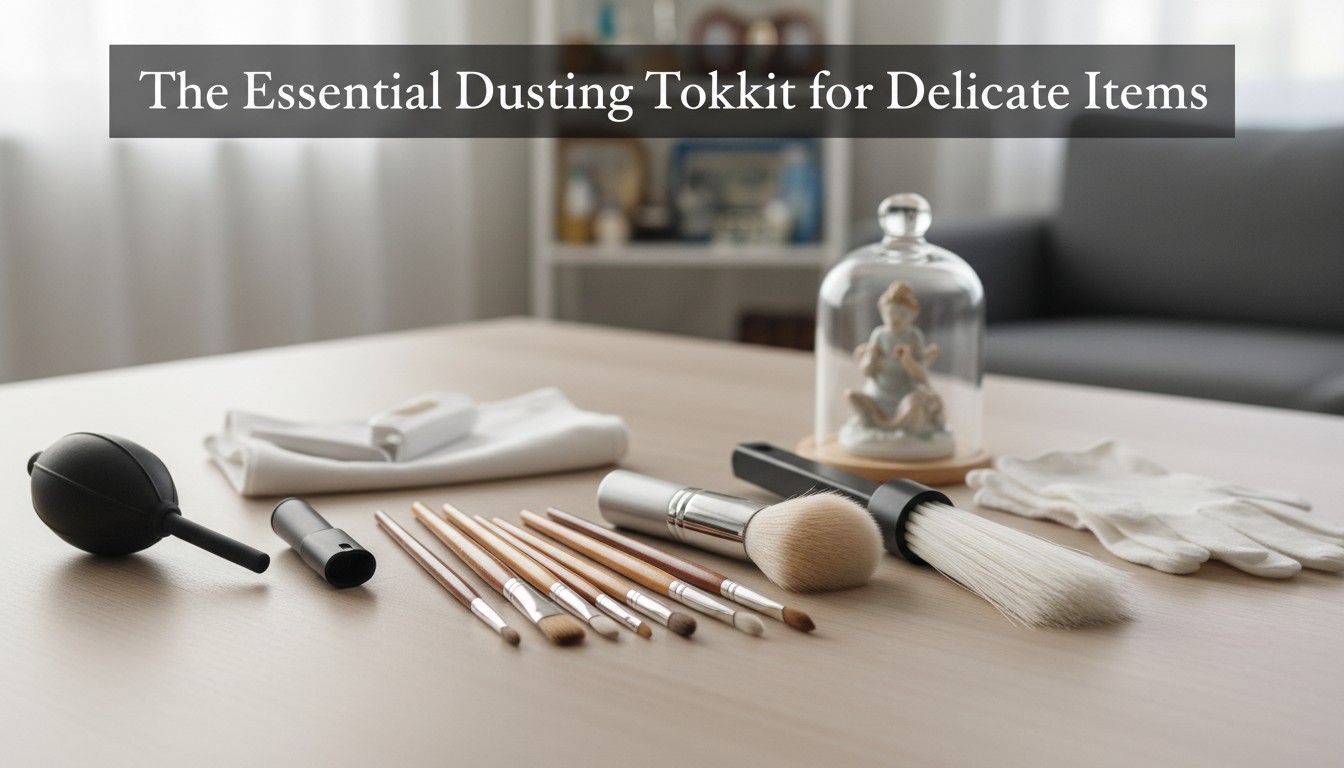
Dry Tools: Clean microfiber cloths, feather duster (for sturdy items only), compressed air can
Brushes: Sable paintbrush, clean makeup brush, soft-bristle toothbrush for stubborn spots
Suction: Vacuum with soft brush attachment, set to lowest power setting
Specialty: Painter’s tape for lifting dust from fabric-covered items , museum-grade gloves for handling
Material Intelligence: The Grammar of Safe Dusting
Every material speaks its own dialect of fragility. Mastering these languages is the difference between preservation and accidental destruction.
Glass and Crystal: The Smudge Magnet
To clean glass ornaments, work from top to bottom with a microfiber cloth . For smudges, use a gentle glass cleaner like Windex on the cloth (never spray directly), then buff with a clean dry cloth . The biggest risk with glass isn’t breaking—it’s leaving streaks that require repeated wiping, increasing handling time and risk. Use minimal product and maximum buffing.
Porcelain and Ceramics: The Handle-With-Everything Approach
These are the prima donnas of delicate decor. Never pick up a figurine by its most dramatic extension (the arm, the hat, the bouquet). Always support from the base with one hand while dusting with the other. For painted details, use a dry sable brush—moisture can lift fragile paint. If crazing is present (fine cracks in the glaze), avoid all liquids; moisture seeps into the body and expands during temperature changes, causing the piece to literally burst from within.
Wood: The Grain Matters
For finished wood, use warm water and a soft cloth, moving with the grain . Unfinished wood may snag microfiber, so use a barely-damp cloth and go with the grain to avoid raising fibers . For ornate carvings, a soft-bristle vacuum brush is essential—dust compressed into crevices becomes abrasive paste that slowly erodes detail. Murphy Oil Soap is safe for finished wood when applied to the cloth first, not the object .
Textiles and Silk Flowers: The Pat-and-Lift Method
Metal and Gilded Surfaces: The Tarnish Tightrope
Gold, silver, or metal ornaments can be cleaned with mild soap and water for tarnished spots . For polishing, use a liquid jewelry cleaner specific to the metal, but treat it like fine jewelry—test first, follow directions precisely, and use jewelry cloths for different metals . Never polish gilded surfaces (gold leaf)—the leaf is only a few molecules thick and will wipe away. Dust gilding with a dry sable brush only.
The Kinesthetics of Safety: How to Move Like a Conservator
Professional conservators can handle 2,000-year-old pottery without trembling because they’ve internalized a set of movement principles that turn anxiety into muscle memory.
The Three-Point Contact Rule
Never handle a delicate object with one hand while dusting with the other. Always maintain three points of contact: two hands supporting the base and one stable surface (your worktable or your body) providing a third anchor. This tripod of stability means if one hand slips, the object doesn’t fall.
Top-to-Bottom, Gravity Is Your Ally
Dust is like snow: it falls from the top to the bottom . Start dusting from the highest items and work your way down to the lowest. If you don’t, you’ll have to repeat your work as dust falls onto cleaned areas . This principle is crucial for multi-tiered displays like curio cabinets—dust the top shelf first, then move downward.
Pat, Don’t Wipe: The Golden Rule
For textured surfaces, embroidery, or anything with raised elements, use the patting motion. A small paintbrush or makeup brush, lightly misted, pats away dust rather than dragging it across delicate fibers . For fabric-covered items, painter’s tape patted against the surface lifts dust without abrasion . Wiping is for stable, flat surfaces only.
The 70% Rule: Never Clean to Capacity
Professional conservators clean objects to 70% of their potential brightness. The remaining 30% of embedded grime is left undisturbed because removing it would require risky interventions. Adopt this mindset: a gentle dusting that removes surface particles is success. Chasing perfection often causes damage.
The Dusting Flow: Sequence for a Multi-Object Display
Step 1: Remove all objects from top shelf, placing on padded surface
Step 2: Dust empty shelf with microfiber cloth
Step 3: Dust each object individually with appropriate tool
Step 4: Return objects using three-point contact
Step 5: Move to next shelf, working downward
Real-World Rescues: Before-and-After Case Studies
The abstract becomes concrete through examples. These case studies demonstrate how strategic dusting completely transformed both objects and owners’ relationships with them.
The Neglected Nativity Scene
For fifteen years, Maria’s 200-piece ceramic nativity stayed boxed after one shepherd’s crook snapped. When she finally unboxed it, the figures were grey with dust. Using a sable brush and compressed air, she dusted each piece without handling them. The three kings required twenty minutes of careful brushing, but not one piece broke. The annual dusting ritual now takes three hours, but the set has remained intact for six years. “The slowness is the point,” she says. “It’s meditation, not maintenance.”
The Silk Flower Revival
David’s grandmother’s silk wedding bouquet had been “too precious to touch” for four decades. The dust had bonded to the silk fibers, turning white petals grey. Using a dry microfiber cloth patting motion and painter’s tape for stubborn areas, he removed 90% of the dust in two hours. The remaining 10% was embedded in the fibers—removing it would have damaged the material. “I had to accept 70% clean,” he says. “The bouquet looks alive again, even if not museum-perfect.”
The Glass Menagerie Disaster (And Recovery)
When Jenna tried to dust her mother’s glass animal collection with a feather duster, a swan’s neck snapped. The breakage trauma was severe—she boxed the remaining 40 pieces for eight years. After learning about three-point contact and microfiber cloths, she forced herself to unbox one piece per week. Each took twenty minutes of careful support and gentle wiping. The collection now lives in a glass-fronted case where dusting is a quarterly event, not weekly terror.
Your Delicate Items Are Begging for Attention, Not Avoidance
The porcelain ballerina, the silk bouquet, the glass swan—they’re not demanding perfection. They’re demanding presence. Every day you avoid dusting them, dust becomes more bonded, more acidic, more permanent. Every gentle cleaning session is an act of preservation, not risk. The tools exist. The techniques are proven. The only missing ingredient is your willingness to touch what you treasure.
Your power to dust without breaking doesn’t depend on professional training or expensive tools. It depends on one thing: the decision to handle with intention rather than fear. The dust is accumulating whether you address it or not. The objects are aging whether you participate in their care or not. You can be the curator who preserves beauty through confident, gentle maintenance, or you can be the anxious owner who preserves dust.
Start small. Pick one object. Support it properly. Use the right cloth. Pat, don’t wipe. Your journey from paralysis to preservation begins with a single act of confident care—and where it leads is a home where every object shines with the attention it deserves, not the neglect it endures.
Key Takeaways
Psychological barriers like breakage trauma and contradiction overload create dusting paralysis—address them with gradual exposure and single-method commitment.
The right tools (microfiber cloths, sable brushes, compressed air, vacuum with soft brush) transform dusting from risk to ritual—technique matters more than effort.
Material-specific protocols are non-negotiable: porcelain needs dry brushing, glass requires top-to-bottom wiping, textiles demand patting with tape.
Master kinesthetic principles: three-point contact, pat-don’t-wipe, top-to-bottom sequence, and the 70% rule (accepting imperfection preserves objects).
Anyone can develop confident dusting skills through a 30-day protocol starting with low-value items and progressing to heirlooms with proper support techniques.
Leave a Reply