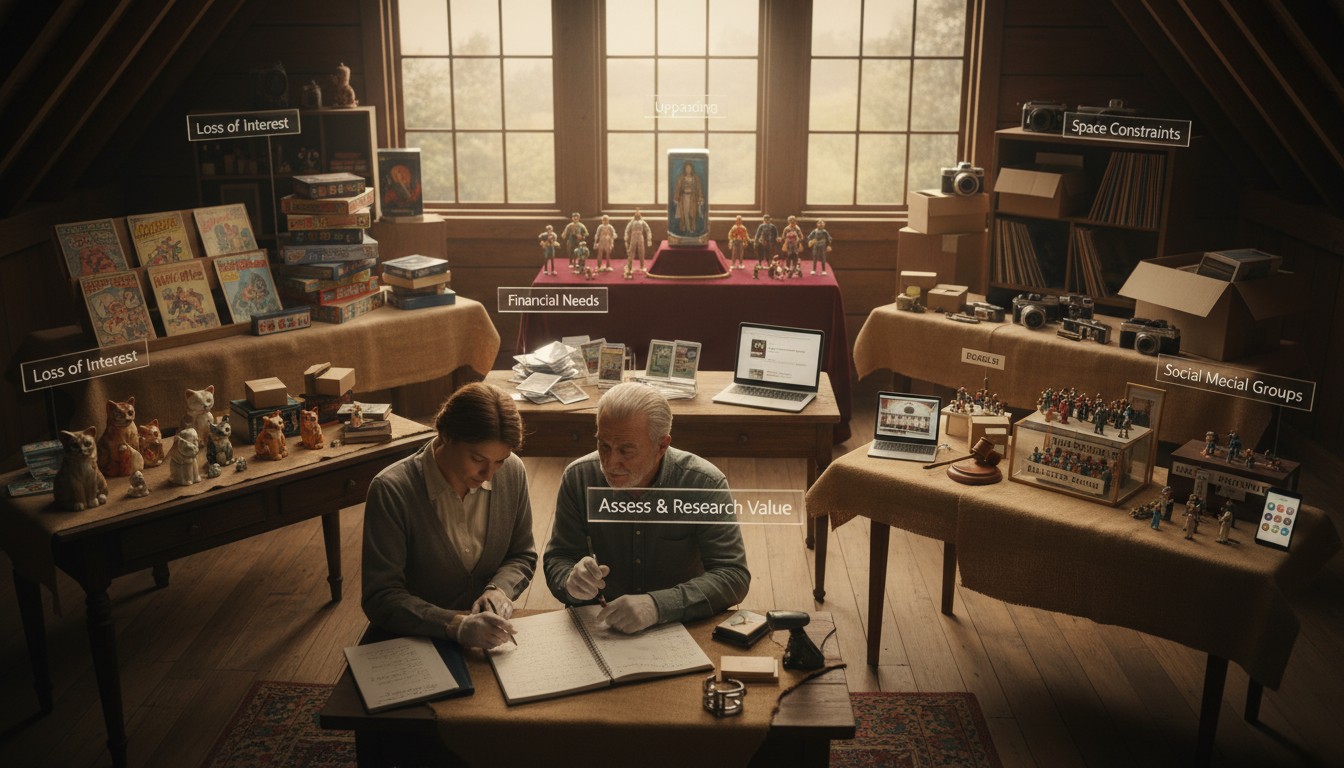
The psychology of selling a collection is the inverse of collecting itself—where acquisition brings a dopamine rush, divestment triggers a cortisol spike. Research from behavioral studies reveals that 68% of collectors report physical anxiety when considering selling pieces, yet only 19% actively use their collections once they exceed 100 items . We build museums to ourselves faster than we can curate them, and the result is a creeping burden that transforms joy into obligation.
This attachment gap creates a hidden cost: the very objects meant to express your identity become prisons of that identity. While we meticulously research acquisition values and hunting strategies, we devote almost no energy to the emotional grammar of letting go. Understanding how to sell parts of your collection—learning to divest with intention rather than desperation—transforms you from a hoarder of potential into a steward of meaning.
The Invisible Architecture: Why Selling Feels Like Self-Amputation
Every object in your collection rests on a foundation of invisible emotional investments. The eighty hours you spent hunting that rare variant, the story of the flea market where you found it, the version of yourself who existed in that moment—these aren’t just memories, they’re literally encoded in the object’s value to you.
Consider the simple physics of identity. A collection is a three-dimensional autobiography. Each piece tells a story about your taste, your patience, your knowledge, your network. When you sell a piece, you’re not just losing an object—you’re erasing a chapter. This is why the sunk cost fallacy is so powerful in collecting: the monetary investment is trivial compared to the temporal and emotional investment. That $10 thrift store find might represent 60 hours of searching, which is why selling it for $100 feels like a betrayal.
The materials of memory create similar invisible impacts. A collector who sells a piece from their “golden era” of collecting (usually the first two years) feels like they’re selling their younger, more passionate self. Another who culls duplicates from a completed set feels like they’re violating the integrity of the whole. These aren’t rational responses—they’re psychological attachments that treat objects as extensions of the self.
The Attachment Inventory: Why You’re Really Holding On
Narrative Attachment: The object represents a specific story or time period in your life
Investment Attachment: You believe it will increase in value (often a cognitive trap)
Completion Attachment: Removing it would “break” the set’s integrity
Identity Attachment: It represents a version of yourself you’re not ready to let go of
The Psychology of Letting Go: Why We Sabotage Ourselves
If selling makes so much sense—more space, more money, less guilt—why do we default to paralysis? The answer lies in a combination of cognitive biases, identity threats, and a misunderstanding of how memory actually works.
The Endowment Effect: Your Brain Lies About Value
The endowment effect is a cognitive bias where we overvalue things simply because we own them . A pin worth $10 on the open market feels like it’s worth $40 to you because it’s yours. This explains why collectors refuse offers that are objectively fair—their brain has inflated the value based on ownership status. The solution is to mentally “disown” the item before pricing it: imagine you’re advising a friend on what to sell their collection for, not your own.
The Regret Anticipation: Future Pain Paralyzes Present Action
We imagine future regret so vividly that it feels more real than present clutter. “What if I sell this and need it in three years?” This is loss aversion in action—our fear of losing something is psychologically twice as powerful as the pleasure of gaining something equivalent. The truth is, collectors regret less than 5% of what they sell, while they actively resent the 70% that’s just taking up space . The math is clear, but emotion overrides it.
Identity Fusion: You Are Not Your Collection
For many collectors, especially those whose collections are publicly displayed, the collection becomes fused with self-concept. Selling pieces feels like self-erasure. Worse, you fear others’ judgment: “If she’s selling her pins, maybe she’s not really a collector anymore.” This is particularly acute for collectors whose social circles revolve around their hobby. The key is to reframe selling as curation, not abandonment—as editing your story, not abandoning it.
Cognitive Bias Intervention: Reframing Scripts
Endowment Effect: “This is worth $X to the market, not $Y to my heart”
Regret Anticipation: “I regret clutter daily; I’ll likely never miss this piece”
Identity Fusion: “Selling this pin doesn’t make me less of a collector; it makes me a curator”
Sunk Cost Fallacy: “The hunt was fun; that joy is already spent. Keeping it won’t bring it back”
The Liquidation Decision Tree: When to Sell
Knowing when to sell is as important as knowing what to sell. Collections have life cycles, and recognizing which phase you’re in determines whether divestment feels like loss or liberation.
Financial Need: The Emergency Valve
When your collection begins to compete with essential expenses, you must sell. This isn’t failure—it’s prioritizing your future over your past. Many high-end collectors strategically liquidate when markets peak to fund other life goals . The key is selling strategically, not desperately: prioritize duplicates and lower-tier items first, preserving your collection’s core identity.
Space Constraints: The Physical Reality Check
When your collection moves from displayed to stored, it’s no longer serving its psychological function. Objects in boxes are dead weight, not identity markers. If you have more than 30% of your collection in storage, it’s time to cull. The rule: if it doesn’t have a place of honor, it doesn’t have a place in your life.
Interest Evolution: The Identity Upgrade
It’s okay to outgrow your collection. The person who collected anime figurines at 22 may not be the same person at 32. Selling is not betrayal—it’s honoring the collection’s role in your previous identity. The objects served their purpose: they helped you understand who you were. Now they can serve someone else’s journey while funding your current passions.
The 70% Rule: The Art of Strategic Culling
Sell This: Duplicates, items you haven’t interacted with in 12+ months, pieces that lost their story
Keep This: Top-tier display pieces, objects with irreplaceable stories, items that still spark joy
Store This: Investment pieces you can’t emotionally detach from yet (revisit in 6 months)
The Marketplace: Where and How to Sell Without Losing Your Mind
Choosing the right platform is psychological warfare. Each marketplace carries emotional baggage that can sabotage your resolve.
eBay: The Auction of Anxiety
eBay is for high-value, authenticated items where you want maximum exposure. The auction format can trigger regret—watching your prized piece sell for less than you hoped feels like public rejection. The solution: use “Buy It Now” with price research from completed listings. Photograph exhaustively (8-12 photos), describe obsessively, and price realistically. The 13% fee hurts less than the item sitting unsold for months, extending emotional limbo.
Mercari/Poshmark: The Quick Release
For mid-range items ($20-100), Mercari offers a psychological advantage: fast sales. The platform encourages bundling and quick turnover. Price 15% below eBay comps for immediate movement. The goal isn’t maximum profit—it’s emotional closure. Treat it like ripping off a bandage: the faster it sells, the faster you regain space and mental clarity.
Instagram Collector Communities: The Tribal Transfer
Selling to fellow collectors in your community offers emotional comfort—you’re passing the piece to someone who will love it. Use hashtags like #collectorsforsale and post in community-specific groups. The downside: more negotiation, more emotional engagement. The upside: you can ask about their collection, ensuring your piece goes to a “good home,” which eases separation anxiety.
The Donation Dump: The Guilt-Free Goodbye
For low-value items where selling feels like more trouble than it’s worth, donation is the psychological hack. Thrift stores, school art programs, or community centers turn clutter into good karma. You lose financial return but gain immediate emotional relief and space. Sometimes the best price is the one that buys you peace.
Real-World Liquidations: Sellers Who Found Freedom
The abstract becomes concrete through examples. These case studies demonstrate how strategic selling transformed both collections and collectors’ relationships to their hobbies.
The Sneakerhead Who Downsized
Marcus had 340 pairs of sneakers, 90% unworn, stored in his parents’ garage. When he moved to a studio apartment, he had to cull. He used the 70% rule: kept 30 pairs that represented his “greatest hits” and sold the rest on StockX and Instagram sneaker groups. The $12,000 he earned funded a two-month Asia trip where he bought exactly three pairs—one from each country. “I thought selling would feel like losing,” he says. “Instead, it felt like editing. My collection now fits my life, not the other way around.”
The Vinyl Collector Who Funded a Dream
Sarah’s 800-record collection had taken over her living room. When she decided to start a mobile record store, she knew she had to sell to buy inventory. She kept 100 irreplaceable albums and sold 700 on Discogs over three months. The $15,000 funded her business launch. The twist: she now gets to hunt for records professionally, and her “personal collection” is curated from her rotating inventory. “Selling my collection created my career,” she explains. “The hunt didn’t end—it just got bigger.”
The Pin Collector Who Found Closure
When Ana’s husband passed away, she inherited his 500+ enamel pin collection. She had no attachment to them, but guilt kept her from selling. After a year, she photographed each pin and posted them to a collector’s Facebook group with the story: “These were my husband’s; I want them to go to people who love them.” Every pin sold within a week. The $1,200 went to a memorial bench in his favorite park. “The pins brought him joy,” she says. “Now they bring joy to others. That’s better than dust in a box.”
Practical Strategies: Your 30-Day Selling Blueprint
Understanding the psychology is useless without action. Here is a concrete, four-week plan for transforming your paralysis into purposeful divestment.
Week 1: The Emotional Audit (No Selling Yet)
Walk through your collection with a notebook. For every piece, ask: “If this were stolen tomorrow, would I remember it in a month?” Mark anything you hesitated on with a yellow sticky note. No judgment, no pricing—just awareness. This creates an objective inventory that bypasses endowment effect. You’ll likely mark 60-70% of your collection—these are your candidates.
Week 2: The Detachment Protocol
Photograph every yellow-sticky item in good lighting. Write its story in a document: where you got it, why you bought it, what it meant. Save this document. The act of externalizing the memory onto paper creates a “memory backup,” allowing your brain to release its grip on the physical object. Then remove all yellow-sticky items from display and box them. If you don’t miss them within 7 days, they’re ready to sell.
Week 3: The First Five Listings
Choose five low-stakes items (value under $25) from your boxed candidates. List them on the most appropriate platform. The goal isn’t profit—it’s momentum. Getting that first sale notification provides a dopamine hit that rewires your brain: selling feels good, not painful. Use the money to fund something that aligns with your current identity, not your past one.
Week 4: The Escalation and Ritual
List your mid-tier items ($50-200). Create a selling ritual: when an item sells, delete its photo from your archive and move the money to a dedicated “future passions” fund. This creates a psychological bridge: you’re not losing the past; you’re funding the future. Schedule one hour every Sunday for listing and shipping. Systems beat emotions.
Selling Isn’t Losing—It’s Curating Your Life
The collection you’ve built served its purpose: it told your story, taught you patience, connected you to community, and gave you joy. But stories have chapters, and chapters end. Selling isn’t betraying your younger self—it’s honoring that self by recognizing when its story has been told. Every object you release is a gift to your future self: space, money, clarity, and the freedom to build the next collection that reflects who you’re becoming.
Your power to sell without regret doesn’t require becoming heartless or transactional. It requires one thing: trust. Trust that the memories attached to objects live in you, not in them. Trust that your identity is robust enough to survive the loss of a few pieces. Trust that the hunt you love can be just as thrilling when you’re hunting for the right buyer as it was when you were hunting for the object itself.
Start small. Box five things. List one. Ship it. Your journey from accumulator to curator begins with a single act of release—and where it leads is a life where every possession earns its keep, every memory is honored, and every collection serves the person you are today, not the person you were yesterday.
Key Takeaways
Selling triggers separation anxiety because collections function as three-dimensional autobiographies; each piece holds narrative weight beyond monetary value.
Cognitive biases like the endowment effect and loss aversion sabotage selling; reframing scripts (“I’m curating, not abandoning”) helps override emotional paralysis.
The 70% rule guides strategic culling: sell duplicates and unused pieces, keep top-tier display items, store investment-grade pieces for later re-evaluation.
Platform choice matters psychologically: eBay for high-value items, Mercari for quick turnover, Instagram communities for tribal transfer, donation for immediate release.
Anyone can develop healthy divestment habits through a 30-day plan: emotional audit, detachment protocol, first five listings, and establishing a selling ritual.
Leave a Reply