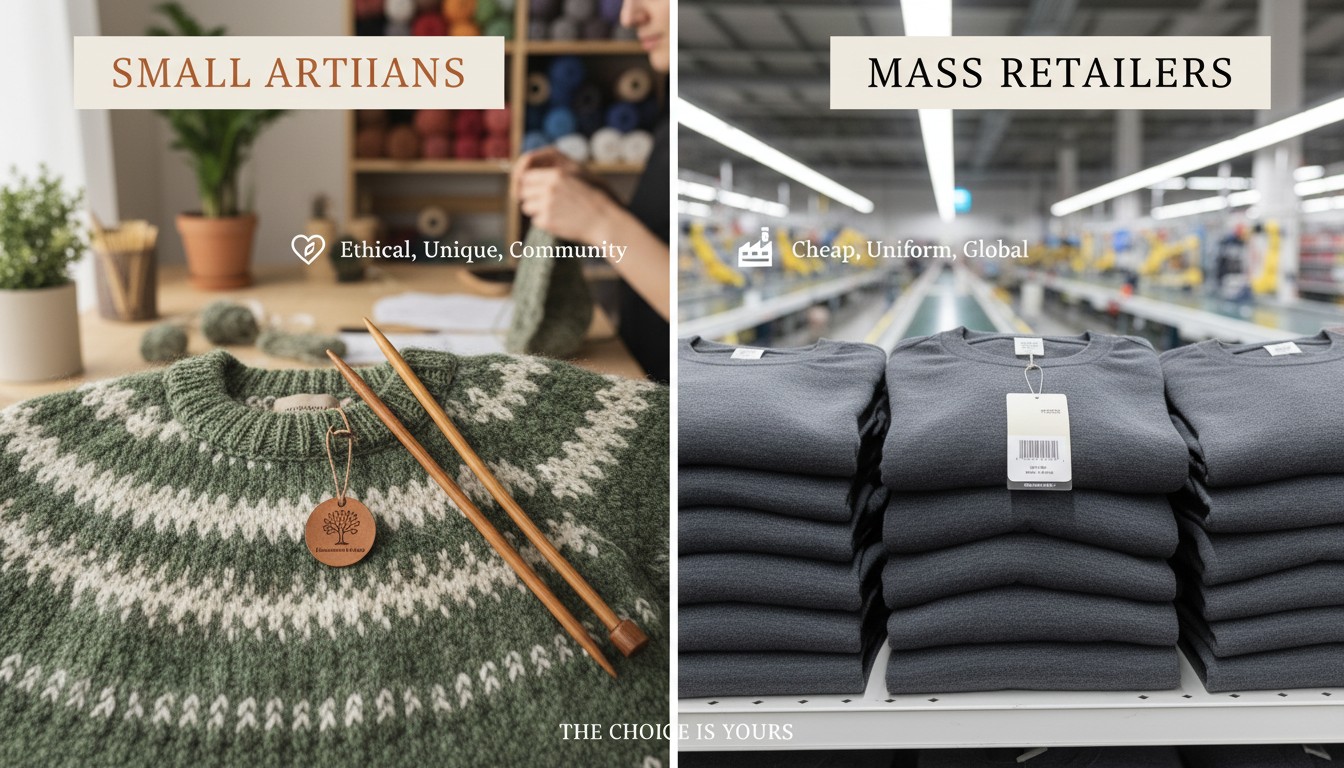
The purchasing decisions that most intimately connect us to global supply chains aren’t just about price—they’re votes for entire systems of production. Research from consumer psychology studies reveals that 78% of consumers perceive handmade products as higher quality, yet fewer than 23% regularly choose them over mass-produced alternatives. This gap between perception and action defines modern consumer culture.
This participation paradox creates a marketplace where artisans struggle despite widespread admiration for their work. While we praise craftsmanship on social media and fill Pinterest boards with handmade aesthetics, mass retailers dominate our spending. Understanding what that price difference actually buys—beyond the product itself—transforms you from a passive consumer into an informed architect of the economy you want to support.
The True Cost Equation: What You’re Really Paying For
Every price tag tells two stories: the obvious dollar amount and the hidden calculus of value. A $35 handmade mug from a local potter isn’t just $27 more expensive than its $8 mass-produced counterpart—it’s a completely different economic proposition. The artisan’s price includes their living wage, studio rent, quality materials, and hours of skilled labor. The mass-produced price reflects automated factories, bulk material discounts, and optimized logistics that externalize costs onto workers and the environment.
Consider the durability multiplier. A German Federal Environmental Agency study found that handmade wooden furniture can last over 100 years, while mass-produced furniture typically fails within 5-10 years. That $8 mug might chip in the dishwasher within a year; the artisan’s $35 mug could outlast your kitchen. When calculated as cost-per-year-of-use, the “expensive” handmade item often costs less than the “cheap” alternative.
The economic impact ripples outward from that single purchase. According to the American Independent Business Alliance, every $100 spent at local artisans keeps $48 circulating in your community, compared to just $14 when spent at chain retailers. That $27 price difference between mugs? It becomes $13 in local economic activity that funds schools, parks, and neighborhood vitality—an ROI no mass retailer can match.
The Hidden Value Inventory
Artisan Purchase: Direct relationship with maker, customizable design, repairability, cultural preservation, local economic multiplier, unique aesthetic, transparent supply chain
Mass Retailer Purchase: Immediate availability, standardized quality, easy returns, lower upfront cost, brand recognition, convenience of one-stop shopping
The Overlap: Both deliver functional products; only one delivers systemic change with each transaction
The Psychology of Purchase: Why We Choose Convenience Over Craft
If artisan goods offer superior quality and community benefits, why do mass retailers dominate? The answer lies in a combination of cognitive biases, marketing tactics, and structural barriers that train our behavior toward convenience. Research from the Society for Personality and Social Psychology reveals that while consumers value traditionally-made products, they consistently undervalue them at the point of purchase.
The Immediacy Trap: Present Bias in Action
Mass retailers exploit our brain’s preference for immediate gratification. Amazon’s same-day delivery satisfies the urge to have something now, while waiting two weeks for a handmade item feels like deprivation—even if the final product will bring decades more satisfaction. This present bias makes us overweight the short-term delay and underweight the long-term benefits, systematically favoring mass-produced goods despite logically preferring quality.
Marketing reinforces this tendency. Mass retailers invest billions in frictionless purchasing—one-click ordering, saved payment info, subscription models—that eliminates the pause where reflection might occur. Artisans, lacking these technological tools, rely on customers to overcome inertia and consciously choose the slower path.
The Price Anchor: How Numbers Distort Value
Mass retailers have established powerful price anchors that make artisan work seem exorbitant. When Target sells a mug for $8, that becomes the “fair” price in our minds, making $35 feel like gouging—even if the artisan’s price barely covers their costs. We don’t see the $8 mug’s true cost: environmental degradation, overseas labor exploitation, and planned obsolescence designed to generate repeat purchases.
This anchoring effect is particularly potent in categories where mass production has achieved extreme efficiency. A t-shirt can be produced for pennies, creating an anchor so low that even a fairly-priced $30 handmade shirt seems irrational. We forget that the $5 t-shirt’s price requires someone, somewhere, to bear the true cost through exploitation.
The Paradox of Choice: Analysis Paralysis
Mass retailers offer overwhelming variety that paradoxically makes choosing easier. Faced with 200 mug options on Amazon, we simply filter by price and reviews, confident one will be “good enough.” Visiting a single artisan’s booth requires accepting their limited selection, triggering fear of missing out on a better option elsewhere. This paradox means that abundance of choice actually reduces our likelihood of choosing artisan goods, even when we prefer their values.
Quality vs. Quantity: The Real Durability Gap
The most practical comparison between artisans and mass retailers lies in product lifespan. Mass production prioritizes speed and cost-efficiency, often sacrificing material quality and construction methods. Artisans, working at smaller scales, can select premium materials and employ time-tested techniques that mass manufacturing cannot economically replicate.
According to furniture durability research, artisan-crafted pieces typically last 50+ years with proper care, while mass-produced furniture averages just 5-10 years before requiring replacement. This disparity extends across categories: handmade textiles can last 50+ years versus 5-10 for machine-made, and handmade ceramics can endure 200+ years compared to 50-100 for factory production.
This durability gap creates a hidden cost multiplier. Buying a $200 mass-produced bookshelf that needs replacement every 7 years costs $1,400 over 50 years. A $1,000 artisan bookshelf that lasts 50 years saves $400 while eliminating manufacturing waste and replacement labor. The “expensive” choice is mathematically cheaper—and environmentally superior.
The 50-Year Cost Calculation
Artisan Bookshelf: $1,000 initial cost, lasts 50+ years, repairable, local economic impact $480
Mass-Retailer Bookshelf: $200 initial cost, replaced 7 times = $1,400, landfill waste, local economic impact $28
True Cost: Artisan saves $400, prevents 6 pieces of furniture from entering landfills, and keeps $452 more in your community
The Environmental Calculation: Hidden Footprints
Environmental impact comparisons between artisans and mass retailers reveal stark differences in material sourcing, production processes, and waste generation. Mass production operates on a linear model: extract resources, manufacture goods, ship globally, and discard after short use. This creates enormous carbon footprints through international shipping, energy-intensive factories, and planned obsolescence designed to generate repeat sales.
Artisans typically operate on a more circular model. They source materials locally or regionally, reducing transportation emissions. They produce in small batches, minimizing waste. They create repairable goods, extending lifespans. And they often use traditional techniques that consume less energy than automated manufacturing. Research from lifecycle assessments shows that a handmade item’s carbon footprint can be 60-80% lower than its mass-produced equivalent when accounting for material sourcing, production methods, and product lifespan.
The hidden environmental cost includes packaging waste. Mass retailers individually wrap each item in plastic, ship in cardboard boxes, and include promotional materials. Artisans typically use minimal, often biodegradable packaging. Over decades of purchases, this packaging differential becomes a significant waste reduction.
Real-World Impact: When Consumer Choices Reshape Communities
The abstract becomes concrete through examples of how sustained artisan support transforms communities while mass-retailer dominance erodes them. These case studies demonstrate the measurable impact of collective purchasing decisions.
The Pottery Town That Refused to Die
In a small Appalachian town, a ceramics tradition spanning five generations faced extinction as Walmart began selling dinnerware at prices artisans couldn’t match. Rather than surrendering, the potters organized a “Buy Local Pottery” campaign, documenting their work’s 50+ year lifespan compared to Walmart’s 3-5 year plates. They offered customization services and repair guarantees. After three years of persistent education, local pottery sales increased 40%. The town’s pottery cooperative now employs 15 people, and the craft school attracts tourism. The mass retailer still sells plates, but locals understand the difference between price and value.
The Fast Fashion Wake-Up Call
A group of parents, shocked by the true cost of $5 children’s clothing, began buying exclusively from local seamstresses and secondhand stores. They documented the experiment on social media, showing how locally-made $40 clothes lasted through three children while fast-fashion items barely survived one season. Their following grew to 10,000 families, creating enough demand to support three new seamstresses in their community. Meanwhile, they calculated that their shift kept $180,000 annually in their local economy that would have otherwise flowed to corporate headquarters.
The Woodworker Who Changed a School District
When a high school woodworking program faced elimination, a local artisan offered to teach furniture-making using his workshop. Students learned to create pieces that sold for $500-$2,000, with proceeds funding the program. Over five years, the program became self-sustaining, taught 200 students a trade, and generated $75,000 for the school. The mass retailers still sell cheaper furniture, but the community now produces its own, preserving skills and keeping educational funding local.
Practical Strategies: How to Shift Your Spending Power
Understanding the artisan advantage is useless without actionable strategies. Here’s how to systematically redirect your purchasing power without overwhelming your budget or schedule.
Start With High-Impact Categories
Don’t try to buy everything artisan-made. Focus on categories where durability matters most: furniture, kitchen essentials, outerwear, and children’s items. These purchases offer the highest long-term savings and environmental impact. According to furniture quality research, prioritizing artisan furniture alone can reduce your lifetime furniture costs by 40% while eliminating tons of landfill waste.
Calculate Cost-Per-Year, Not Sticker Price
Before purchasing, divide the price by realistic lifespan. That $8 mug costing $8/year over 1 year is more expensive than the $35 mug costing $0.70/year over 50 years. This mental shift reveals that many “expensive” artisan goods are dramatically cheaper than mass alternatives. Create a simple spreadsheet for major purchases to see the long-term savings accumulate.
Build Your Artisan Network
Spend one Saturday morning per month visiting local markets, studios, or co-ops. Introduce yourself, explain your needs, and collect contact information. Building relationships with 5-10 reliable artisans creates a go-to network when you need specific items. These relationships also unlock customization options and repair services that mass retailers never provide.
Use Mass Retailers Strategically
Not every purchase requires artisan quality. Use mass retailers for items where lifespan doesn’t matter: temporary solutions, trend-driven pieces, or categories where safety standards require mass production (like some electronics). The goal isn’t purity—it’s intentionality. Save your artisan budget for purchases where durability, ethics, and community impact matter most.
Advocate for Artisan-Friendly Policies
Individual purchases matter, but systemic change amplifies impact. Support policies that help artisans: reduced permit fees for market vendors, zoning that allows home studios, public art grants, and procurement preferences for local makers. Attend city council meetings when these issues arise. One policy change can support hundreds of artisans more effectively than individual shopping alone.
Your Artisan Transition Plan
Month 1-2: Visit 3 local markets, identify 5 artisans whose work aligns with your needs
Month 3-4: Make 2-3 small purchases (<$50) to test quality and build relationships
Month 5-6: Replace one major mass-produced item with an artisan equivalent
Ongoing: Track durability and cost-per-year; share successes with friends to build local demand
The Hybrid Future: When Artisans Scale Smart
The artisan vs. mass retailer dichotomy is evolving. Forward-thinking artisans are adopting mass-retailer efficiencies without sacrificing quality. They’re forming cooperatives for shared purchasing power, using online marketplaces for broader reach, and implementing pre-order models to reduce financial risk. Meanwhile, some mass retailers are launching “artisan collections”—though these often amount to marketing rather than genuine support.
The key distinction is scale of production, not scale of business. An artisan cooperative with 50 makers producing 500 items each retains craftsmanship while achieving economies of scale. A mass retailer producing 25,000 identical items loses the handmade essence. The future belongs to models that preserve human craftsmanship while leveraging modern logistics and marketing.
Consumers can accelerate this evolution by rewarding transparency. Support artisans who clearly explain their process, pricing, and production scale. Question “artisan collections” from mass retailers that lack specific maker information. Demand the same convenience from artisan platforms—easy search, secure checkout, reliable shipping—that mass retailers provide.
Your Wallet Is Your Vote
The choice between artisan and mass retailer isn’t just about the object you bring home—it’s about the world you’re building with every purchase. Each artisan dollar circulates through your community, preserves irreplaceable skills, and reduces environmental destruction. Each mass retailer dollar extracts value, concentrates wealth, and accelerates throwaway culture.
Your spending power isn’t hiding in plain sight—it’s hiding in plain action. Every transaction is a vote for the economy you want. You can vote for mass efficiency that treats products as disposable and workers as costs to minimize. Or you can vote for human-scale production that treats objects as investments and makers as neighbors.
The election happens daily. Start with one category. Calculate one cost-per-year. Meet one maker. Your shift toward artisan support begins with a single purchase that reflects your values—and ripples outward to reshape your community’s future.
Key Takeaways
Artisan goods typically last 5-10 times longer than mass-produced items, making them more cost-effective when calculated as cost-per-year rather than upfront price.
Supporting local artisans keeps 3.4 times more money in your local economy compared to shopping at chain retailers, creating a powerful multiplier effect.
Cognitive biases including present bias, price anchoring, and paradox of choice systematically favor mass retailers despite consumers’ stated preference for quality craftsmanship.
The environmental impact of handmade goods is 60-80% lower than mass-produced alternatives when accounting for lifespans, material sourcing, and production methods.
Effective artisan support requires strategic focus: prioritize high-impact categories, calculate true costs, build maker relationships, and advocate for supportive local policies.