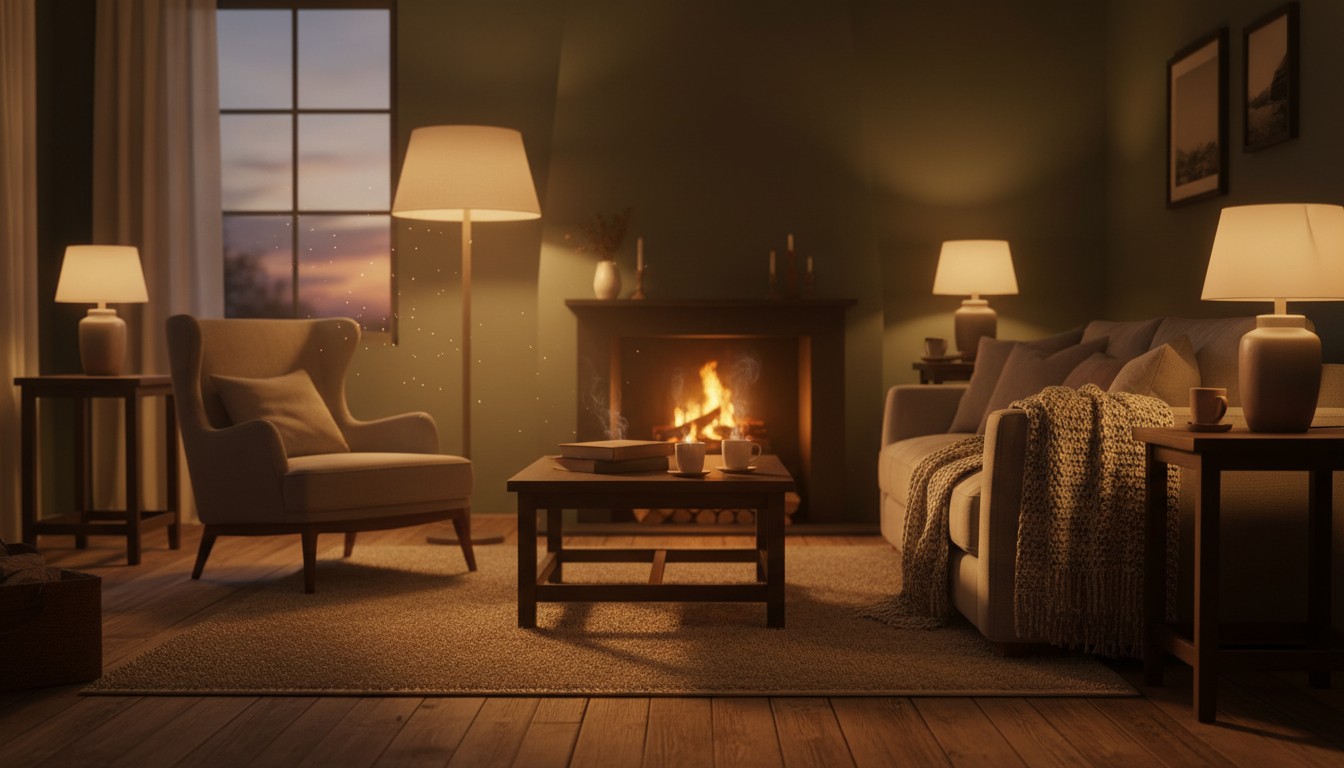
The illumination that most profoundly affects our mental state isn’t natural sunlight—it’s the artificial lighting we’ve surrounded ourselves with. According to neuroscience research, ambient light directly regulates mood by altering circadian rhythms, hormone secretion, and neurotransmission through specialized cells in your retina that bypass vision entirely. Yet fewer than 12% of homeowners can accurately describe how color temperature affects their emotional state.
This knowledge gap creates a dangerous default: we accept whatever lighting came with our home, never realizing that the anxiety we feel at night or the morning grogginess we battle might be lighting-driven. While we obsess over furniture layouts and paint colors, the electromagnetic wavelengths bouncing off those walls—measured in tiny degrees Kelvin—are quietly orchestrating our serotonin and melatonin levels. Understanding how to wield ambient lighting transforms you from a passive occupant of lit spaces into an active designer of your emotional environment.
The Science of Sight: How Light Rewires Your Emotions
Light influences mood through two distinct pathways: the visual system you know, and a non-image-forming system that directly impacts your brain’s emotional centers. Specialized retinal ganglion cells detect light intensity and color, then project signals to the suprachiasmatic nucleus (your body’s master clock) and the prefrontal cortex (emotion regulation headquarters). This bypasses conscious vision entirely—explaining why you can feel lighting’s effects even with your eyes closed.
The hormonal cascade is immediate and powerful. Morning exposure to bright light suppresses melatonin and boosts serotonin, improving alertness and positive affect. Evening exposure to cool, blue-rich light does the opposite: it delays melatonin production, disrupts sleep architecture, and increases cortisol, creating a low-level stress response that many mistake as their “natural” nighttime anxiety. Studies confirm that exposure to bright light before bedtime alters sleep patterns and mood, while warm lighting promotes healthier circadian rhythms.
Color temperature is your mood thermostat. Measured in Kelvin (K), lower temperatures (2700K-3000K) produce warm, yellowish light that triggers relaxation responses. Higher temperatures (5000K-6500K) emit cool, blue-white light that increases alertness and can heighten anxiety. Research from USAI Lighting reveals that high illuminance with cool light increases anxiety and hostility, while the same brightness with warm light reduces these negative moods. The effect is particularly strong in women, whose negative mood decreased significantly under warm light and increased under cool light.
The Three Layers of Mood: Ambient, Task, and Accent
Professional lighting designers don’t think in terms of single fixtures—they think in layers. Each layer serves a distinct psychological function, and their combination creates emotional depth that single-source lighting cannot achieve. According to Architectural Digest’s mood lighting guide, layering warm lighting below 3000K prevents spaces from feeling visually cold and institutional.
Ambient Lighting: The Emotional Foundation
Ambient light provides overall illumination and sets the baseline emotional tone. It’s the first layer to address because it influences every other lighting choice. In living areas, warm ambient light (2700K) creates a welcoming, cozy atmosphere that encourages relaxation and social connection. In workspaces, slightly cooler ambient light (3000K-3500K) promotes alertness without creating anxiety.
The key is diffusion. Harsh overhead lights create sharp shadows and emotional tension. Soft, diffused ambient light—achieved through lampshades, frosted fixtures, or indirect lighting—produces an even glow that feels safe and contained. As designers emphasize, there should never be a bare bulb in the house; diffused light softens harshness and creates emotional comfort.
Task Lighting: Focus and Function
Task light directs attention and energy. Bright, focused task lighting (4000K-5000K) enhances concentration for reading, cooking, or detailed work. But this stimulating light should be contained to the task area and time—using it throughout the evening confuses your circadian system into believing it’s perpetual afternoon.
The psychological trap is installing task lighting that spills into the rest of the room. A reading lamp should illuminate your book, not your entire living room. This containment allows you to shift emotional states by simply turning task lights on or off, creating distinct zones of focus and relaxation within the same space.
Accent Lighting: Emotional Punctuation
Accent light creates visual interest and emotional highlights. It draws attention to objects that bring joy—artwork, plants, architectural details—subconsciously reinforcing positive emotions. A small uplight behind a favorite sculpture or a under-cabinet light illuminating a beautiful countertop adds depth and dimension that makes a room feel cared for and personal.
Accent lighting’s power lies in its scarcity. Too much accent light creates visual chaos, raising stress levels. One or two carefully placed accent sources, however, give the eye pleasant places to rest, reducing cognitive load and creating a sense of visual calm.
The Mood Layer Cake: How to Stack Them
Base (Ambient): 2-3 sources of warm, diffused light at 2700K-3000K
Middle (Task): 1-2 focused sources at 3500K-4000K, positioned for specific activities
Top (Accent): 1 highlight source, directed at meaningful objects, creating visual rest
The Color Temperature Thermostat: Fine-Tuning Your Emotions
Color temperature is the most powerful mood dial in your home, yet most people never adjust it. The Kelvin scale runs from candlelight (1800K, deeply relaxing) to daylight (6500K, intensely alerting). Each 500K shift creates measurable changes in heart rate, cortisol levels, and subjective mood ratings.
The research is striking: Studies show women prefer lower color temperatures (warmer light) and are more sensitive to its mood effects, while younger subjects respond more strongly to blue-rich light than older adults. The PER3 gene variant even determines individual sensitivity—some people need dramatic lighting shifts to feel an effect, while others respond to minor changes.
Practically, this means your home should have no “neutral” lighting—it should shift throughout the day. Morning: 4000K-5000K cool light for alertness. Afternoon: 3500K neutral light for sustained focus. Evening: 2700K warm light for relaxation. This daily cycle mimics natural sunlight patterns, synchronizing your circadian rhythm and stabilizing mood.
The Psychology of Neglect: Why We Live in Bad Light
If lighting so powerfully affects mood, why do we tolerate harsh, inappropriate illumination? The answer lies in a combination of status quo bias, complexity aversion, and the invisible nature of light’s effects.
The Invisibility Problem
Unlike a lumpy couch or ugly paint, bad lighting doesn’t immediately register as the source of discomfort. We feel anxious, tired, or irritable without connecting it to the 6500K LED overhead that’s been blasting us since sunset. This disconnect prevents us from addressing the root cause, leading to symptomatic solutions: drinking more coffee for fatigue, taking medication for anxiety, or buying calming products when simply adjusting light temperature could resolve the issue.
The Complexity Overload
Lighting technology has exploded with options: smart bulbs, color-changing LEDs, dimmers, sensors, and apps. This technical complexity paralyzes decision-making. Most homeowners default to whatever bulb was on sale, surrendering their emotional environment to cost rather than intention. The result is a home lit for utility, not well-being.
The Inherited Default
We inherit lighting from previous occupants and never question it. That fluorescent kitchen fixture or cool-white bathroom vanity becomes a permanent fixture because “it came with the house.” This status quo bias prevents us from recognizing that lighting should be personalized to our circadian rhythms, work schedules, and emotional needs—not left as a generic default that serves no one’s optimal mood.
The Inherited Lighting Audit
Take Inventory: Walk through your home at 8 PM and note every light source’s color temperature (check bulb packaging or use a color temperature app)
Identify Offenders: Any light above 4000K after sunset is likely disrupting your mood and sleep
Calculate Cost: Replacing 10 problematic bulbs with warm LEDs costs $50-80—less than one therapy session or sleep aid prescription
Real-World Impact: When Lighting Changes Everything
The abstract becomes concrete through documented cases where intentional lighting design transformed emotional well-being and daily functioning.
The Insomnia Cure
A software developer struggling with chronic insomnia discovered his bedroom’s “warm” LED bulbs were actually 4000K—cool enough to suppress melatonin. He replaced them with 2700K bulbs and installed dimmers that automatically lowered brightness to 20% after 9 PM. Within two weeks, his sleep latency decreased from 45 minutes to 15 minutes, and his sleep tracker showed 30% more deep sleep. The $60 lighting upgrade solved what $2,000 in sleep consultations couldn’t address.
The Anxiety Reduction
A graduate student experiencing heightened evening anxiety realized her apartment’s overhead 5000K lights created a sense of perpetual alertness. She installed smart bulbs programmed to shift from 5000K at 5 PM to 2700K by 8 PM. Her self-reported anxiety scores dropped 40% over one month, and she stopped needing evening wine to unwind. The programmed temperature shift became an external cue that helped her nervous system transition from work mode to rest mode.
The Productivity Boost
A writer working from home replaced her single overhead light with a three-layer system: warm ambient floor lamps, a cool task light for her desk, and a small accent light on a bookshelf. Her daily word count increased 25% and she reported feeling less “mentally exhausted” at day’s end. The ability to switch between lighting layers throughout the day gave her brain external signals for different work modes, reducing decision fatigue.
Budget Breakdown: The Cost of Emotional Control
Rewiring your home’s mood through lighting is surprisingly affordable. The average American home has 40 light bulbs; replacing all of them with smart, dimmable LEDs costs less than a single piece of furniture, yet affects your emotional state more profoundly. The investment pays for itself through improved sleep quality, reduced anxiety, and increased productivity.
The key is strategic replacement: start with the spaces where you spend the most evening hours (living room, bedroom), then expand to high-impact areas (kitchen, bathroom). According to interior design professionals, mixing light sources at different heights and styles creates the most emotionally satisfying environments—meaning you don’t need expensive fixtures, just variety.
Practical Strategies: Room-by-Room Mood Design
Understanding lighting theory is useless without room-specific application. Each space in your home serves distinct emotional functions and requires tailored lighting strategies that support those functions rather than fighting them.
The Bedroom: Sanctuary Mode
Your bedroom should emotionally signal “sleep is coming.” Use only 2700K sources: bedside lamps with warm bulbs, never overhead lights. Install dimmers and set evening brightness to 20-30%. Add blackout curtains to control natural light intrusion. The goal is creating a gradual transition from day to night that mirrors sunset, triggering melatonin production.
The Living Room: Social Flexibility
Living rooms need emotional adaptability. Start with warm ambient floor lamps (2700K) for general coziness. Add a cooler task light (3500K) near reading chairs that can be turned on for focus, off for relaxation. Use accent lights on artwork or plants to create visual interest that draws the eye away from screens. Design professionals recommend mixing lamp heights and styles to create texture and depth that feels layered and intentional.
The Kitchen: Energizing Precision
Kitchens need bright, accurate light for safety and task performance. Use 4000K-5000K under-cabinet lighting for food prep areas. But this stimulating light should be switchable—install separate controls so you can turn off task lighting and switch to 3000K ambient light when the kitchen transitions from workspace to social space during dinner parties.
The Bathroom: Morning Boost
Bathrooms benefit from cool morning light (5000K) around the vanity to energize you for the day. But add a separate 2700K nightlight or under-vanity lighting for evening routines. This prevents the sleep-disrupting blast of cool light during 11 PM bathroom trips and creates a spa-like atmosphere for evening relaxation.
The Home Office: Sustained Focus
Home offices need 3500K-4000K task lighting positioned to avoid screen glare. But crucially, this space should have a “shutdown ritual”: a switch that turns off task lighting and activates warm ambient lighting at 5 PM, signaling the workday’s end. This external cue prevents the blurred boundaries that lead to burnout in remote workers.
The 7-Day Lighting Reset Plan
Day 1-2: Audit every bulb in your home with a color temperature app
Day 3: Replace bedroom and living room bulbs with 2700K warm LEDs
Day 4: Install dimmer switches in your two most-used rooms
Day 5: Add one table lamp to create light source variety
Day 6: Set up a task light in your work area, separate from ambient
Day 7: Create an evening routine: dim all lights to 30% brightness 2 hours before bed
The Compound Effect: How Small Changes Accumulate
Lighting’s impact compounds over time. A single warm bulb in your bedroom might help you fall asleep 10 minutes faster tonight. But when every room in your home supports your circadian rhythm—bright, cool mornings; warm, dim evenings—your entire sleep-wake cycle stabilizes. After three months of consistent lighting patterns, research shows measurable improvements in depression scores, sleep quality, and daytime alertness.
The feedback loop is powerful: better sleep improves mood, which makes you more motivated to maintain healthy lighting patterns. This accumulation effect explains why lighting design is a high-leverage intervention. Unlike exercise or diet changes that require daily willpower, automated lighting systems work silently in the background, continuously supporting your biology without conscious effort.
The encouraging corollary is that anyone can begin this process. You don’t need an electrician’s license or a design degree. You just need to replace one bulb, install one dimmer, or buy one lamp. Show up for your circadian rhythm the way you’d show up for a workout—consistently, even if imperfectly. Over time, your lighting becomes the invisible architecture of your emotional well-being.
Your Mood Is Hiding in Plain Sight
The light that surrounds you isn’t neutral illumination—it’s a continuous mood drug you’re dosing yourself with every waking hour. Those harsh overheads that make you anxious, the cool screens that keep you awake, the dim corners that drag down your energy—they’re not facts of nature, they’re choices you’ve accepted.
Your power to reshape these choices doesn’t require a renovation or an electrical engineering degree. It requires one thing: the decision to see light as a tool for emotional design rather than a utility to take for granted. The bulb is already there whether you choose it or not. The mood impact is already happening whether you acknowledge it or not. You can be the person who designs your emotional environment, or you can be the person who suffers in the default.
The choice is yours. Start small. Change one bulb. Install one dimmer. Notice how you feel tonight. Your journey toward intentional mood lighting begins with a single switch—and the determination to flip it with purpose.
Key Takeaways
Light affects mood through non-visual pathways that regulate circadian rhythms, serotonin, melatonin, and cortisol, with warm light (2700K-3000K) reducing anxiety and cool light increasing alertness.
Layering three light types—ambient (general mood), task (focused energy), and accent (visual interest)—creates emotional depth that single-source lighting cannot achieve.
Women and younger individuals show stronger sensitivity to lighting’s mood effects, but everyone benefits from matching light temperature to time of day and activity.
A complete home lighting upgrade costs $75-600 depending on tier, with essential mood improvements achievable for under $120 by replacing 10 bulbs and adding 2 dimmers.
Consistent lighting design that follows circadian patterns—cool mornings, neutral afternoons, warm evenings—delivers measurable improvements in sleep quality, mood stability, and daytime alertness within three months.