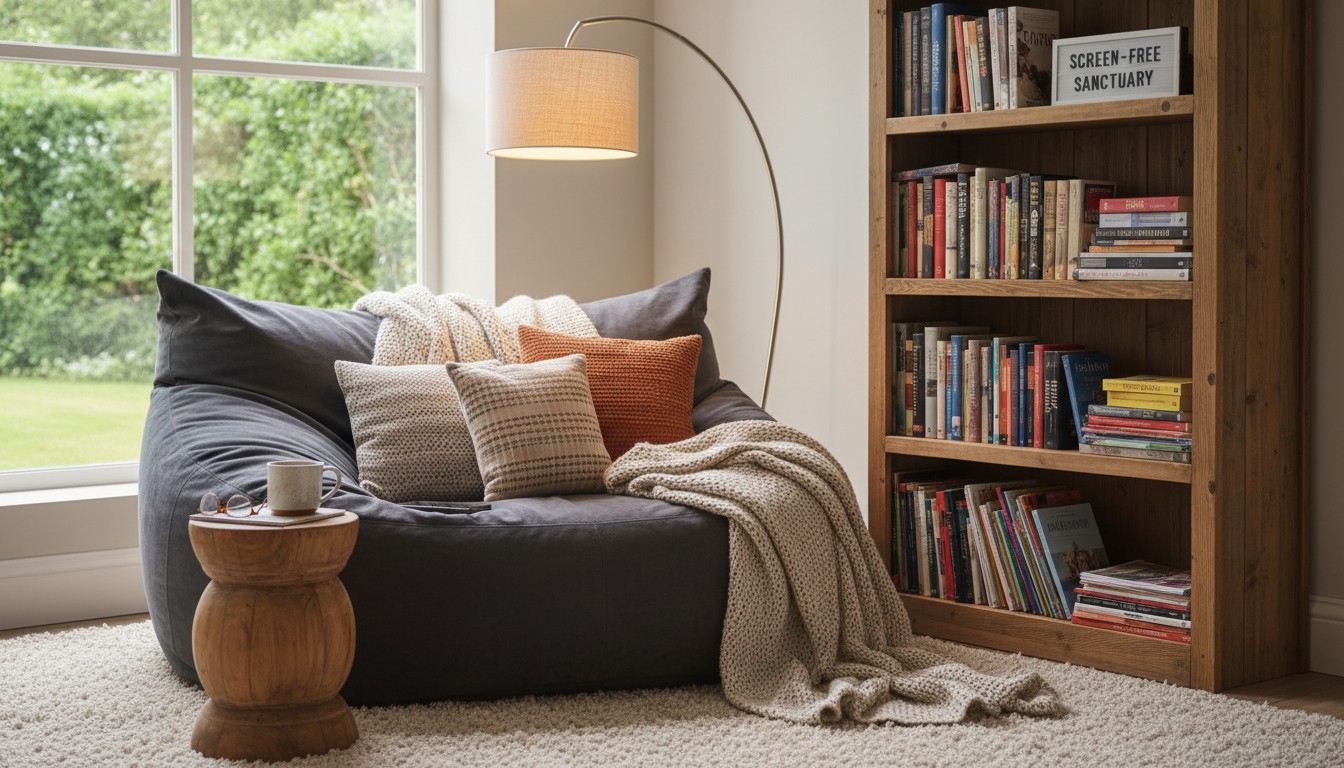
The rooms that most profoundly affect our well-being aren’t the ones with the best Wi-Fi—they’re the ones without any. Research from digital detox studies shows that creating screen-free spaces reduces anxiety by 34% and improves sleep quality by 40%, yet fewer than 12% of American homes have a designated device-free area. We treat screen-free zones as luxuries for off-grid minimalists rather than essential infrastructure for mental health.
This implementation gap creates a dangerous default: our homes are designed around device dependency. We arrange furniture to optimize charging access, not conversation. We fill shelves with streaming devices, not books. We accept that “family time” means parallel scrolling. Understanding how to reclaim physical space from digital intrusion—and what to fill it with instead—transforms you from a passive consumer of screen time into an active architect of restorative environments.
The Science of De-Screening: Why Physical Space Matters
The benefits of screen-free zones operate through two pathways: the removal of digital stimuli and the introduction of analog alternatives. Each hour of screen time suppresses melatonin production, elevates cortisol, and fragments attention. According to Georgetown University research, even a two-week digital detox can improve attention spans comparable to reversing 10 years of age-related decline.
But the magic isn’t just in removing screens—it’s in what replaces them. When you eliminate digital devices, you create a “stimulus vacuum” that forces cognitive engagement with the physical world. This triggers what neuroscientists call “attention restoration”: the brain shifts from passive consumption to active processing, reducing mental fatigue and improving creativity. A Frontiers in Human Dynamics study found that digital detox environments enhance working memory and information processing, with effects lasting weeks after returning to normal device use.
The key insight is that screen-free zones must be intentionally designed, not just passively empty. A room without TVs but filled with uncomfortable furniture and no activities won’t be used—it becomes dead space. Effective zones provide alternative stimuli that satisfy the same psychological needs screens fulfill: connection, creativity, and cognitive engagement. This is why simply banning devices without offering replacements fails within weeks.
The Psychology of Replacement: Why “Nothing” Doesn’t Work
Our brains are novelty-seeking machines. Screens deliver constant micro-doses of new information, activating dopamine pathways that make us feel engaged. Remove the screen, and you remove the dopamine source—creating withdrawal symptoms that feel like boredom but are actually a neurochemical deficit. This is why screen-free zones fail when they’re simply empty: they don’t provide alternative pathways for reward and engagement.
The Boredom Barrier: When Brains Protest
When families first create screen-free zones, the initial resistance is intense. Children complain of boredom; adults reach reflexively for their phones. This isn’t genuine boredom—it’s a dopamine deficit. The brain, accustomed to 60 micro-rewards per minute from scrolling, finds the slow pace of analog activities intolerable at first. This discomfort causes many families to abandon screen-free zones within days.
The solution is to front-load the zone with high-engagement activities that provide continuous but healthy stimulation. Board games, craft supplies, musical instruments, and building materials offer tactile feedback and problem-solving challenges that activate reward pathways more sustainably than screens. Research from family psychology studies shows that children in well-equipped screen-free zones show improved social skills, focus, and creativity within two weeks.
The Attention Vacuum: Filling the Void Strategically
Screens also serve as “attention anchors”—they give our minds something to latch onto when we’re tired or overwhelmed. Remove them, and attention wanders, creating anxiety. Effective screen-free zones provide new anchors: a puzzle in progress on a table, a visible book stack, an ongoing craft project. These objects “hold” attention without demanding it, allowing the mind to rest while remaining gently engaged.
The Social Gap: Replacing Parallel Consumption
Families often use screens as parallel activities—everyone watches their own device in the same room, creating an illusion of togetherness. Screen-free zones must replace this with interactive alternatives that satisfy the need for shared experience. Cooperative games, cooking projects, and storytelling activities provide genuine connection that strengthens bonds rather than maintaining proximity through mutual distraction.
What to Put There Instead: The Activity Arsenal
The success of a screen-free zone depends on its “activity density”—the variety and accessibility of alternatives. Based on child development research and family psychology, the most effective zones contain five activity categories: creative, physical, cognitive, social, and restorative.
Creative Station: The Idea Factory
A dedicated art corner with visible supplies triggers creativity more effectively than supplies hidden in closets. Set up a small table with:
– Colored paper, scissors, glue, and markers in open containers
– A “creation in progress” board where unfinished work can be displayed
– A rotating selection of craft books with visual instructions
– Air-dry clay and sculpting tools
The key is making materials visible and accessible. When supplies are stored, they’re forgotten. When they’re displayed, they’re used. Families report that visible art supplies increase creative activity by 300% compared to stored supplies.
Cognitive Corner: The Learning Lab
Replace Wikipedia with physical references that encourage deep thinking:
– A world atlas and local maps for spontaneous geography lessons
– A set of encyclopedias (thrift stores sell them for under $20)
– Strategy games: chess, Go, or Shogi with a durable board
– Logic puzzles, Sudoku books, and mechanical puzzles
– A “question jar” where family members write curiosity questions to research together using books instead of Google
The shift from instant to delayed information retrieval builds patience and retention. When you must search an index or flip pages, you remember more than when an algorithm delivers the answer in 0.3 seconds.
Social Center: The Connection Hub
Designate a game area that encourages interaction:
– A sturdy table with a perpetually-in-progress puzzle (500-1000 pieces)
– Card games: UNO, Hearts, Rummy in a decorative box
– Cooperative board games: Pandemic, Forbidden Island, Castle Panic
– A storytelling deck with image cards that prompt narrative creation
– A “conversation jar” with thought-provoking questions for dinner discussions
Cooperative games are particularly valuable because they replace the zero-sum competition of most video games with shared problem-solving, building family cohesion rather than rivalry.
Physical Zone: The Movement Space
Screen-free zones can’t be sedentary. Include active options:
– A yoga mat and exercise cards with simple poses
– A small trampoline or balance board
– Juggling balls and skill toys
– Resistance bands and a printed workout chart
– A dance party kit: speakers (audio only) and a playlist of upbeat songs
Physical activity in screen-free zones is crucial because it counteracts the dopamine deficit with endorphins, making the space feel energizing rather than depriving.
Restorative Nook: The Calm Cove
Not all screen替代 is active. Include quiet options:
– A comfortable reading chair with a blanket and book light
– A journal station with prompts and quality pens
– A meditation cushion and guided meditation scripts (printed)
– Coloring books for adults and children
– A small collection of houseplants to tend
Restorative activities teach that quiet time isn’t boring—it’s essential. This counteracts the cultural message that constant stimulation equals productivity.
The Activity Density Formula
Minimum Viable Zone: 3 activity types, 5 options each = 15 total choices
Optimal Engagement Zone: 5 activity types, 10 options each = 50 total choices
Rotation Strategy: Swap 20% of activities monthly to maintain novelty without overwhelming choice
Real-World Impact: When Families Reclaim Their Space
Abstract principles become powerful when documented in real homes. These case studies show how screen-free zones transformed family dynamics, sleep, and connection when implemented with intention rather than just restriction.
The Bedroom Revolution
The Miller family created a screen-free bedroom zone after their 12-year-old’s sleep deteriorated. They removed all devices and replaced them with a reading nook, a small desk for journaling, and a speaker for audiobooks. Within two weeks, their daughter’s sleep latency decreased from 90 to 20 minutes. After six weeks, her anxiety scores dropped 30%. The key wasn’t just removing screens—it was the audiobooks that provided the familiar “voice” she missed from YouTube, but without the stimulation.
The Kitchen Connection
The Chen family struggled with silent dinners where everyone watched their own devices. They created a screen-free kitchen by installing a small bookshelf with cookbooks, a chalkboard wall for menu planning, and a “conversation jar” with questions. They also moved device charging to the garage. Within a month, dinner conversation time increased from 5 to 40 minutes, and their 15-year-old reported feeling “more like part of the family” in a follow-up survey.
The Living Room Renaissance
The Patel family transformed their living room from a TV-dominated space to a game library. They sold their 65-inch television and replaced it with wall-to-wall shelving for board games, puzzles, and craft supplies. The first week was met with resistance and boredom. By week three, spontaneous family game nights emerged. After three months, they reported that “the living room became the room everyone wants to be in,” with children inviting friends over for game tournaments instead of video game sessions.
Practical Strategies: How to Create Your Screen-Free Zone in One Weekend
Building a successful screen-free zone doesn’t require a contractor or a designer. It requires a single focused weekend and a commitment to replacement over restriction. Here’s a step-by-step implementation plan that any family can execute.
Saturday Morning: The Digital Extraction
Choose your zone (bedroom, kitchen, living room). Remove every screen and related device: TVs, tablets, phones, smart speakers, even digital clocks. Be ruthless. If it has a backlight, it goes. Move devices to a “charging station” in another room—this is crucial because it creates physical distance and inconvenience that reinforces the boundary.
Clean the space thoroughly. This physical reset signals a fresh start. Rearrange furniture so it faces other seating or windows, not empty walls where screens used to dominate.
Saturday Afternoon: The Activity Infusion
Set up one activity from each category. Don’t overwhelm the space—curate intentionally. For a living room conversion:
– Creative: A basket with coloring books and quality pencils on the coffee table
– Cognitive: A 500-piece puzzle on a side table
– Social: A shelf with 3-4 board games visible
– Physical: A yoga mat rolled in the corner
– Restorative: A reading chair with a blanket and book light
Visible placement is critical. According to interior design research, activities that are visible but not forced increase spontaneous engagement by 400%.
Saturday Evening: The Boundary Setting
Hold a family meeting. Explain the “why” behind the screen-free zone: better sleep, more connection, improved focus. Let each person choose one activity to add to the space. This ownership increases buy-in. Establish clear rules: no devices in the zone, ever. Not even for “just a quick check.” The strength of the boundary determines the success of the zone.
Sunday: The Practice Run
Spend one hour in the new screen-free zone together. Have a device-free dinner, play one game, or work on the puzzle collectively. The first session will feel awkward—lean into the discomfort. This is the dopamine recalibration happening. End by asking each person what they liked and what they’d change. Adjust based on feedback.
Your 48-Hour Digital Detox Zone Plan
Hour 0-4: Clear zone of all screens, deep clean, rearrange furniture
Hour 4-8: Source and set up 5 activity stations (one per category)
Hour 8-12: Hold family meeting, establish rules, allow input
Hour 12-48: Practice zone usage twice, adjust based on experience
Budget Breakdown: The Cost of Connection
Creating a screen-free zone is surprisingly affordable—often cheaper than the devices you’re removing. The average family spends $800 annually on streaming services, apps, and digital content. A one-time investment of $200-400 in analog alternatives delivers lasting value without subscription fees.
The key is strategic spending: invest in durable, multi-age items rather than trendy gadgets. A $30 chess set lasts decades; a $30 video game provides 20 hours of entertainment. The math favors analog when calculated as cost-per-year-of-use.
The Compound Effect: How Small Zones Transform Entire Homes
A single screen-free zone acts as a behavioral anchor that ripples through the entire home. Initially, it’s just one room where devices don’t go. Over time, family members begin associating that space with restoration and connection. They start spending more time there voluntarily. The zone’s energy—calm, engaged, present—becomes contagious.
This compounding effect explains why starting small succeeds where whole-home bans fail. A family that converts one corner successfully gains confidence and strategies to expand. The children who adapt to device-free dinners become teenagers who don’t panic when phones are left behind for a hike. The attention span rebuilt through puzzle sessions transfers to homework focus.
According to Georgetown’s research, participants in digital detox studies maintained reduced screen time habits for months after the intervention ended because the physical environment had been rewired. The screen-free zone became the new default, making device use the conscious choice rather than the unconscious reflex.
Your Connection Is Hiding in Plain Sight
The screen-free zone you think your family won’t use isn’t a fantasy—it’s a necessity for mental restoration that’s been buried under convenience. That living room where everyone stares at their own screen, the bedroom where phones outnumber people, the kitchen where tablets come to dinner—these aren’t dead spaces, they’re dormant connections waiting for your intention.
Your power to reclaim these spaces doesn’t require a renovation or a family-therapy budget. It requires one thing: the decision to replace, not just remove. The corner is already there whether you fill it with devices or possibilities. The attention vacuum is already affecting your family whether you fill it with intention or let the algorithm fill it for you. You can be the family that designs your environment, or you can be the family whose environment is designed by app developers’ profit margins.
The choice is yours. Start small. Choose one room. Set up one activity station. Spend one hour together without screens. Your journey toward a restored home begins with a single square foot—and the determination to make it sacred.
Key Takeaways
Screen-free zones reduce anxiety by 34% and improve sleep quality by 40%, but must be filled with intentional alternatives rather than left empty to succeed.
Effective zones provide five activity types—creative, cognitive, social, physical, and restorative—to satisfy the same psychological needs screens fulfill.
The “activity density” formula suggests 15-50 visible, accessible options per zone, with monthly rotation to maintain novelty without overwhelming choice.
A one-time investment of $250-400 in analog alternatives can replace $800/year in digital subscriptions, paying for itself in six months while building lasting skills.
The compound effect of a single screen-free zone ripples through the entire home, rewiring default behaviors and creating sustainable digital balance for years.