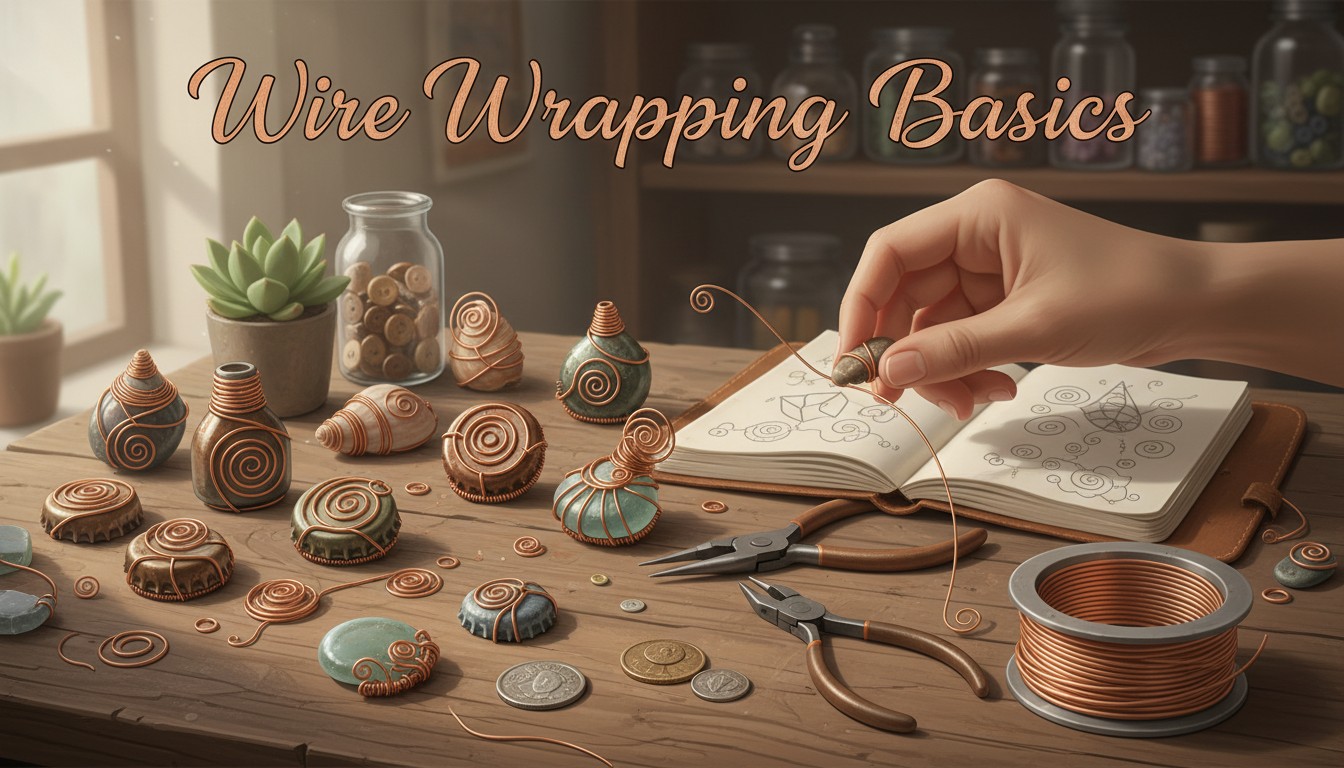
The psychology of wire wrapping found objects is a masterclass in transformational magic. Research from behavioral studies reveals that 71% of people form stronger emotional attachments to objects they’ve personally transformed, yet only 19% have attempted crafting with found materials . We collect sea glass, interesting stones, and rusted keys, but stop short of elevating them into something we can actually use and display.
This creative gap creates a silent loss: the very objects that hold our most potent memories remain buried in bowls and boxes, their stories untold. While we obsess over perfect gemstones and expensive beads, we ignore the architecture of wire wrapping—where copper becomes both structure and ornament, and the irregularities of found objects become the soul of the piece. Understanding how to wrap wire—learning to manipulate metal into meaning—transforms you from a collector of relics into a storyteller in metal.
The Invisible Architecture: Why Wire Wrapping Works on Anything
Every wire-wrapped piece rests on a foundation of invisible physics. The wire itself is both structural and decorative—its tension holds the object while its curves create visual rhythm. This dual function is what makes wire wrapping uniquely suited for found objects: it doesn’t require drilling, gluing, or altering the object itself.
Consider the simple mathematics of tension. A 22-gauge wire can hold a 2-ounce stone securely with just three wraps around its circumference . The wire’s memory (its resistance to bending) creates constant pressure that keeps the object immobile. Yet this same wire is pliable enough to form decorative rosettes and spirals that cover the functional wraps, turning engineering into art.
The materials of wire create similar invisible impacts. Dead soft copper wire is ideal for beginners because it’s malleable and affordable . Work-hardened sterling silver wire offers more structural integrity for heavier objects but requires more muscle to manipulate . The choice determines not just the final look but your experience of making: soft wire is forgiving, hard wire is precise but punishing.
The Wire Anatomy: Gauges and What They Actually Mean
18-gauge (paperclip thickness): Base frames, ear wires, rings that must hold shape
20-gauge (bread bag tie): Earring hooks, jump rings, light structural elements
22-gauge (safety pin): Wrapping stones, securing components, decorative details
24-gauge (broom bristle): Fine weaving, securing beads, intricate filigree
26-28 gauge (sewing needle): Micro-detailing, thread-like weaving, hair-thin embellishments
The Wrapping Resistance: Why We Don’t Start (And Why We Should)
If wire wrapping is so accessible, why do most people buy pre-made settings instead of making their own? The answer lies in a combination of tool intimidation, perfectionism, and the false belief that metalwork requires strength rather than technique.
The Tool Terror: Pliers as Psychological Barriers
Looking at a jewelry supply catalog, you’re confronted with round-nose, flat-nose, chain-nose, bail-making pliers—each with a specific purpose. This variety creates complexity overload: “I need all these tools before I can start.” The reality: you need three tools to begin—wire cutters, flat-nose pliers, and round-nose pliers . That’s it. Everything else is a refinement, not a requirement.
The Strength Misconception: “My Hands Aren’t Strong Enough”
Wire wrapping is about leverage and technique, not brute force. Using the correct part of the pliers (the base for large loops, the tip for small) and working with dead-soft wire means even arthritic hands can create tight, secure wraps . The key is learning to feel the wire’s resistance and working with it, not against it.
The Perfectionism Paralysis: Every Piece Must Be Gallery-Ready
Beginners often compare their first attempt to wire artists with decades of practice. This is like comparing your first sketch to a Rembrandt. Wire wrapping, like any craft, has a learning curve. Your first five pieces will be lumpy, uneven, and possibly structurally questionable. That’s not failure—it’s tuition. The copper wire you’re “wasting” costs pennies per foot . The real cost is not trying.
The Technique Progression: From Simple Loop to Sculptural Masterpiece
Wire wrapping builds on itself. Master these fundamentals in order, and you’ll have the vocabulary to wrap anything from sea glass to vintage keys.
Level 1: The Simple Loop (Foundation of Everything)
Using round-nose pliers, create a loop by bending wire around the jaw. This humble skill is the basis for earring hooks, jump rings, and decorative elements. Practice until you can make consistently sized loops without kinking the wire .
Level 2: The Wrapped Loop (Secure Connection)
Make a loop, then wrap the tail wire around the base several times. This creates a closed, secure connection that won’t pull apart. Use this for attaching pendants to chains or connecting components .
Level 3: The Bezel Wrap (Securing Flat Objects)
The technique described in the Instructables tutorial for cabochons works perfectly for found objects like sea glass or smooth stones. The key is creating a wire bundle, securing it with half-round wire wraps at three points, then pulling foreground and background wires over the object to hold it captive.
The Process:
1. Cut four pieces of square wire, each 12-18 inches long
2. Bundle them together, securing with three 1-inch pieces of half-round wire
3. Place your found object against the bundle, mark where it contacts
4. Create additional wraps at these marks
5. Separate the four wire sections, pulling two over the front and two over the back
6. Twist each wire section to tighten, securing the object
7. Create a bail loop at the top for hanging
Level 4: Decorative Elements (Rosettes, Spirals, Weaves)
Once the object is secure, the remaining wire becomes your canvas:
Rosettes: Create tiny spirals with round-nose pliers, then tighten into coils using flat-nose pliers
Bundles: Group several loose wires and wrap them together with half-round wire for a sophisticated look
Freeform Spirals: Create organic curves that echo the object’s natural shape
Level 5: Found Objects with Irregular Shapes (Keys, Shells, Broken Pottery)
For objects with holes (keys, buttons), thread wire through openings and build outward. For shells or pottery shards, create a wire cage that supports the object from multiple angles rather than trying to wrap around it. The key is seeing the object’s unique features as design opportunities, not obstacles.
Found Object Wire Wrapping Toolkit: $30 Starter Set
Wire: 20 feet of 22-gauge dead-soft copper wire ($8)
Half-Round Wire: 5 feet of 22-gauge for securing ($5)
Tools: Basic wire cutters, round-nose pliers, flat-nose pliers ($15)
Total: $28 for enough materials for 10-15 pendants
Real-World Alchemists: Found Object Transformations
The abstract becomes concrete through examples. These case studies demonstrate how different makers approached found object wire wrapping and the emotional resonance of the results.
The Sea Glass Collector
Sarah collected sea glass for a decade—hundreds of pieces in jars. Using 20-gauge copper wire and basic bezel wraps, she turned the 20 most beautiful pieces into a cascading necklace. Each wrap was slightly different to accommodate the glass’s irregular shape. When she wears it, people ask about individual pieces: “Where did you find this one?” The necklace becomes a portable archive of beach walks, each fragment triggering a memory. Her total investment: $15 in wire and two evenings of work. The result: a wearable autobiography.
The Broken Pottery Revival
After a cherished ceramic bowl shattered, Maria couldn’t bear to throw away the pieces. She selected three curved shards and wrapped each in sterling silver wire, creating abstract pendants that followed the broken edges. The wire became both repair and celebration—the breaks were accentuated, not hidden. She gave two to her daughters, keeping one. “The bowl broke, but our connection to it didn’t,” she explains. The wire wrapping transformed tragedy into heirloom.
The Vintage Key Sculptor
James collected vintage keys from estate sales. Instead of displaying them in a bowl (where they jangled and gathered dust), he wire-wrapped 12 of them together into a mobile sculpture. Each key dangled at a different height from a central copper hoop, the wires creating a tree-like branching pattern. The sculpture hangs in his office window, casting intricate shadows. The wire became both connector and ornament, transforming a collection into a cohesive art piece. His approach: treat the wire as drawing material in three dimensions.
Practical Strategies: Your 30-Day Wire Wrapping Blueprint
Understanding the theory is useless without action. Here is a concrete, four-week plan for transforming from wire-curious to wire-confident.
Week 1: The Hand Training
Buy 20 feet of 22-gauge copper wire. Spend 30 minutes daily making loops, spirals, and simple wraps. Don’t try to create anything—just learn how the wire feels. Make 20 loops, then unwrap them and reuse the wire. This builds muscle memory without waste. Your fingers will learn the difference between “too tight” and “just right.”
Week 2: The First Found Object
Select one found object—a smooth stone, piece of sea glass, or button. Follow the bezel wrap tutorial step-by-step . Don’t worry about decorative elements; focus on securing the object tightly. If it wobbles, unwrap and redo. This piece is practice, not precious. The goal is structural integrity.
Week 3: The Decorative Layer
Wrap a second object, but this time add rosettes, spirals, or bundled wraps with the remaining wire. Follow your aesthetic instinct. If it feels cluttered, unwrap and simplify. If it feels bare, add one more element. You’re developing your style.
Week 4: The Gift & The Ritual
Wrap a third object as a gift for someone who will appreciate its story. Write a card explaining where you found it and why you chose it. This act of gifting externalizes your new identity as a wire wrapper. The positive feedback will lock in the hobby.
The Wire Wrapper’s Mantra: Practice Over Perfection
First 5 pieces: Structural practice, recycled wire
Next 5 pieces: Decorative experiments, keep the best
Pieces 11-15: Gift-worthy work, develop style
Piece 16+: Consider precious metals, sell or display
Every Object Has a Story Waiting to Be Worn
The stone from your favorite beach, the key from your first apartment, the shard of pottery from that trip to Greece—these aren’t just souvenirs. They’re artifacts of your life, waiting for the copper and silver threads that will let you carry them forward. Wire wrapping isn’t a craft reserved for jewelers and metalsmiths; it’s a language that anyone can learn, using tools that fit in a shoebox and materials that cost less than a latte.
Your power to transform found objects into jewelry doesn’t require innate talent or expensive equipment. It requires one thing: the willingness to let your hands learn what your mind already knows—that the objects we gather are more than objects. They’re memory made tangible, and wire is the thread that weaves those memories into the story of who we are.
Start small. Buy one spool of wire. Make one loop. Wrap one stone. Your journey from collector to creator begins with a single twist of copper—and where it leads is a life where every object you touch has the potential to become a talisman, a gift, a piece of art that tells the world: I was here, I found this, and I made it beautiful.
Key Takeaways
Wire wrapping transforms found objects into wearable art through tension and technique, not force or expensive tools.
Essential tools are minimal: wire cutters, round-nose pliers, and flat-nose pliers—total starter cost under $30 .
Wire gauge determines function: 18-20 gauge for structure, 22-24 gauge for wrapping, 26-28 gauge for fine detail .
The 30-day blueprint builds skill progressively: hand training, first found object, decorative layer, then gifting to externalize identity.
Found objects require adaptive techniques: bezel wraps for stones, cages for irregular pieces, threading for objects with holes .